I Checked 12 Platforms for Commission-Only Salespeople. I Kept Coming Back to One.
Most of what is written about hiring commission-only salespeople is written by people who have never done it. It is either a platform selling you a subscription, or a listicle that has not been updated since 2023 and still recommends a company whose domain is now parked for sale.
So I did the work properly. Twelve platforms, checked against their own terms of service rather than their landing pages, against their actual review history rather than their testimonials, and against their company filings rather than their about page.
Three of them are worth your money. Several are actively worth avoiding. And one of them, despite having real problems that I am going to lay out honestly, is the one I keep going back to.
This is the long version, for anyone in Mastermind Pakistan who is thinking about building a sales team without a payroll.
First, the uncomfortable maths
Before any platform recommendation, you need to understand why most commission-only hires fail, because it is not the reason you think.
It is not that the reps are lazy. It is a cash flow mismatch, and it is brutally simple.
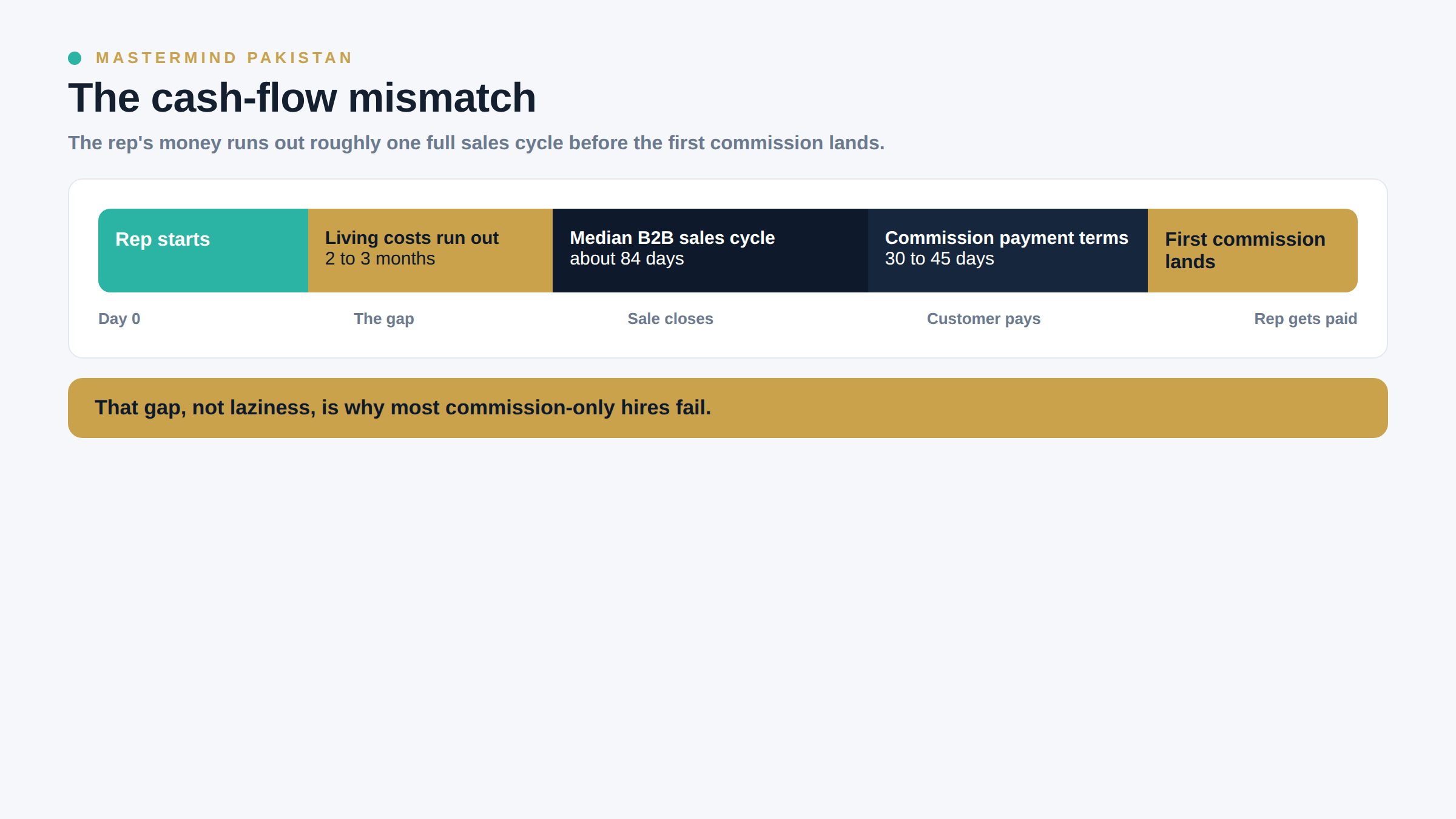
A survey of around 2,000 sales professionals found that commission-only reps need to cover their living costs within two to three months of starting. That is not a preference, that is rent.
Meanwhile the median B2B sales cycle sits at 84 days. Then add your commission payment terms on top, which might be another 30 to 45 days after the customer pays.
Put those two facts next to each other. The rep’s money runs out roughly one full sales cycle before your first commission ever lands in their account. That is the whole failure mechanism, and it has nothing to do with how good your product is or how motivated they were in the interview.
Two more numbers that should shape your expectations:
A typical independent sales rep carries six to ten product lines at once, and spends only about 28% of their time actually selling anything. Your offer is not getting a salesperson. It is getting a slice of a slice of one person’s week.
And median annual earnings for commission-only reps run roughly $10,000 to $30,000 depending on the industry, while a salaried B2B account executive in the US sits near $190,000 on target. The people who can genuinely sell have a guaranteed alternative. Pure commission mostly clears the market at the bottom.
I am not telling you this to talk you out of it. I am telling you because every single thing that made this work for me was a direct response to one of those four numbers.
What actually makes it work
Commission-only is normal in insurance, real estate, solar, roofing, home improvement and high-ticket coaching. It is close to unheard of in early-stage software. That is not a coincidence, and the difference comes down to five conditions:
- A short cycle. Closeable in 30 days or less, ideally one or two calls.
- Per-deal commission above $1,000. The rep needs a believable path to real money inside 90 days.
- A category the buyer already understands. If your rep has to educate the market first, you are asking them to personally fund your marketing budget.
- A proven, documented sales motion. Scripts, objection handling, references, a close rate you can quote out loud.
- Leads or appointments that you supply. This is exactly why the setter and closer split exists at all.
If you have most of those, keep reading. If you have none of them, no platform on this page will save you, and I would rather tell you that now than take a referral fee from you later.
The platform I keep coming back to
CommissionCrowd.
I want to be careful here, because the point of this article is not to sell you a subscription. It has real problems and I am going to spend a section on them. But it is the one that has actually produced for me, and the reason is worth understanding.
What it actually is
It is the only true self-serve commission-only marketplace operating at any real scale. Not a recruiting agency you brief and wait on. You post an opportunity, you search agents yourself, you message them directly, and you run the relationship in their software.
I went through the platform again while writing this piece, and here is what is actually there rather than what the homepage claims.
The counters at the time of writing showed roughly 31,000 registered agents, 2,433 companies, and 1,980 live opportunities. Agent distribution is genuinely global with 180+ countries represented, led by the USA at around 6,187, the UK at 4,744 and Canada at 1,756.
More useful than the totals is the industry mix of what is actually being sold on there. The top categories are Information Technology and Services at 633, Computer Software at 471, Marketing and Advertising at 394, Internet at 192, and Management Consulting at 118. Further down you find everything from Renewables to Medical Devices to Logistics.
That mix matters. This is not a manufacturers’ rep database full of people selling furniture into retail chains. It skews heavily toward technology, software and marketing services, which is exactly where most of us in this community are operating.
What a real listing looks like
Here is one live on the platform right now, so you can see the shape of a good offer rather than a theoretical one.
A company selling legacy software modernisation to SaaS businesses. Average deal size £5,000 to £25,000. Commission at 25%, so the agent earns £1,250 to £6,250 per project. Territory covers the EU, North America, Australia, Ireland, New Zealand and the UK. Repeat business is explicitly built in, with agents continuing to earn on accounts they introduced.
Then read the part most people skip. The listing says plainly: “Leads provided: No leads provided.”
And yet the offer still works, because it compensates on the other levers. The commission per deal is high enough to matter. The sales cycle is stated in weeks rather than months. The company handles all the technical discovery and closing, so the agent only has to open and qualify. And the pitch has a hard number in it, 40 to 60% cheaper than traditional consultancies, which makes it easy to communicate.
That listing is a masterclass in how to write for this audience. It is not asking a rep to be a hero. It is removing every reason for them to say no.
The part that actually matters
Everything above is nice. This is the bit that made the difference.
CommissionCrowd does the boring operational work that nobody else does. Contract builder with e-signature. Onboarding and training modules you can assign. Collaborative sales pipeline. Agent activity and performance tracking. File hosting. And commission payment processing built in.
Every other option on my list hands you a name and an email address and wishes you luck. That sounds fine until you have four agents in three countries, no shared pipeline, no signed agreement that says when commission is earned, and no idea which of them has actually made a call this month. That is when commission-only teams quietly die.
The platform is not what finds you the rep. The platform is what stops you losing them in month three.
Now the problems, and there are real ones
I am not going to pretend this is a clean recommendation. Read these before you pay anything.
The percentage is not a one-time placement fee. The pricing page shows 2% on the Basic plan and 1% on Premium. What the pricing page does not put in large type is what the terms actually say: that percentage applies to all commissions paid to any agent introduced through the platform, for the full lifetime of that relationship. If you find someone great and they sell for you for five years, the platform is taking a cut for five years. Price that in from day one.
The contract minimum contradicts itself. The pricing page markets a three-month minimum on Premium. The terms of service say twelve months. Subscriptions are explicitly non-refundable once a billing cycle starts, and cancellation has to be in writing. Get the minimum confirmed by email before you pay, and keep that email.
Payments run on Stripe, and that is a genuine problem from Pakistan. Pakistan is not on Stripe’s list of supported countries. The UAE is supported but restricted, requiring a trade licence and a specific account type. So if you are running a Pakistani entity, you can subscribe and use the platform, but you will end up paying your agents outside it. That removes one of the main reasons to pay for it. Plan for this, do not discover it after you have signed a 12-month commitment.
The site shows its age in places. The testimonials page has nothing dated after 2016. Blog posts carry no dates at all. Their own help documentation on the payments system still references a figure from August 2020. None of that means the company is dead, and I will come to why in a second, but it does mean you should verify anything time-sensitive rather than trusting the page.
The independent review base is thin. Trustpilot sits at 4.9 across roughly 110 to 140 reviews. Outside of that, there is almost nothing. No meaningful G2 presence, no Capterra ratings, no organic community discussion. For an eleven-year-old company that is a genuine signal and you should weigh it.
Against all of that, one hard fact that outweighs a lot of the noise: Commission Crowd Limited, company number SC454318, registered in Edinburgh, incorporated in July 2013, is active with accounts filed through July 2025 and a confirmation statement filed in July 2026. No overdue filings. You can check the filing history yourself on Companies House.
That is a real company with a real paper trail that anyone can check in about ninety seconds. In a category absolutely full of one-page websites with a Calendly link and no registered entity, that counts for a great deal.
Why it still wins for me
Here is the honest version of why I keep going back, and it is not because the platform is perfect.
Because the first hire is the only hard one.
Everything above about cash flow mismatch and 28% selling time and reps carrying ten lines is true, and it is why the first few months feel like nothing is happening. You will screen a lot of people. Most will go quiet. You will start to think the whole model is broken.
Then one person closes something.
And the entire situation changes, for reasons that compound.
You now have a case study written in the only language a commission-only rep understands, which is money someone actually received. Your next listing does not say “great opportunity, uncapped earnings.” It says a specific person earned a specific amount in a specific timeframe. That single change does more for your applicant quality than any amount of subscription tier upgrading.
You now know your real numbers. Your actual close rate on cold-opened deals, your actual cycle length, your actual per-deal commission. You stop guessing at your offer and start engineering it.
Your first producer becomes a recruiting asset. Good commission-only reps know other commission-only reps. They talk. An agent who is getting paid will bring you people that no platform search will ever surface.
And your process finally exists. The scripts are written because someone used them. The objection handling is real because someone hit those objections. The contract terms are tested because someone signed them. Agent number two onboards into something that works, instead of into a blank page.
That is the actual return on a platform like this. You are not buying 31,000 agents. You are buying enough shots on goal to find the one person who turns your offer from theory into evidence. Once you have that evidence, everything downstream gets cheaper, including the next hire.
Which is exactly why I would tell you to judge this decision on a twelve-month horizon and not a thirty-day one. A 30-day trial of commission-only sales is theatre. It tells you nothing except that sales cycles are long, which you already knew.
The two alternatives worth knowing
I said three platforms were worth your money. In fairness, here are the other two.
HyperHired. A done-for-you recruiting agency rather than a marketplace, so you do not browse and choose. Pricing is placement-contingent and works out around $1,500 per hire on a ten-hire engagement, with a replacement guarantee. It has by far the most verifiable track record in this whole category, with 32 named client companies you can look up and phone. Clutch rating of 4.3 across 12 reviews, and reviewers do flag inconsistent communication. Their proven vertical is home services, insurance and door-to-door, not software or coaching. If you need volume in field sales, this is the strongest option available.
Salesfolks. Free to post, and you only pay when you actually hire, at $500 for a 1099 contractor. That is the cheapest legitimate entry point I found anywhere, with no subscription and no cut of commissions, and they explicitly support commission-only when most platforms quietly refuse. Two catches. Roles must credibly pay $100,000+ on-target earnings or you cannot list. And the validation is genuinely thin, with 13 reviews on G2 of which 10 were posted in a single eight-day window in March 2024 and nothing since. Treat it as a $500 experiment rather than a strategy.
How the platforms compare, side by side
Every named platform from the review, in one place. Read the “what you actually pay” column twice, because that is where most of the surprises live.
| Platform | What it actually is | What a business pays | Commission-only allowed | Verdict |
|---|---|---|---|---|
| CommissionCrowd | Self-serve marketplace, 31,000 agents, with contracts, pipeline and payments built in | 2% (Basic) or 1% (Premium) of every commission, for the lifetime of the agent relationship | Yes, it is the whole model | Recommended, once you have priced in the lifetime cut |
| HyperHired | Done-for-you recruiting agency, you brief and they place | Around $1,500 per hire on a ten-hire engagement, contingent on placement | Yes | Recommended for volume in field sales, not for software |
| Salesfolks | Job board, free to post, pay only on hire | $500 per 1099 hire, no subscription, no cut of commissions | Yes, explicitly | Worth a $500 test, but validation is thin |
| DealFuel (formerly Closify) | Talent network that charges both sides | Reps pay $495 for lifetime access, business placement fee undisclosed | Yes | Avoid, paying to join corrupts the vetting |
| Closers IO | Sells training to reps, then places those reps with you | $15,000 to $18,000 placement plus $3,000 to $8,000 per month, after charging reps around $8,400 | Yes | Avoid, and note the BBB listing on its alternate name |
| Dial A Closer | The most convincing marketplace interface of the lot | Not published anywhere, pricing page 404s, retainer required despite the “only pay for results” claim | Unclear | Avoid until the pricing is public and a human is named |
| Setters & Closers Co | One-to-ten person personal brand | Core price never stated, upsells priced at $1,497 per month, 90 day lock-in, $20,000 per month revenue gate | Unclear | Avoid, no entity, no team page, no third-party reviews |
| Overpass | Hiring marketplace for remote sales staff | Not relevant, every contract must carry an hourly rate | No, prohibited in their own FAQ | Does not solve this problem |
| Activated Scale | Managed sales talent, retainer model | $3,000 to $12,000 per month | No, they advise against it | Does not solve this problem |
| Sellai | Defunct | Domain is listed for sale at around $45,995 | Not applicable | Dead, ignore any list that still includes it |
| CloseCrew | Does not exist | Not applicable | Not applicable | Does not exist |
The pattern is easy to miss when you read these one at a time, so here it is plainly. The three that work all make money the same way you do, which is when a rep sells something. The ones to avoid make money either before anyone sells anything, or from both sides at once.
What to avoid, and exactly why
This part might save someone reading this a five-figure mistake, so I am being specific.
Anything that charges the reps too
This is the single most important filter in this entire category.
DealFuel, formerly Closify, charges sales reps $495 for lifetime access to its talent network, then charges businesses an undisclosed placement fee on top. Closers IO sells aspiring closers a training course at around $8,400, then sells businesses a $15,000 to $18,000 placement plus $3,000 to $8,000 per month, staffing them with people from that same pool.
Think about what that does to the vetting. When a platform earns from both sides, willingness to pay quietly becomes a selection criterion instead of ability to sell. You would be paying fifteen thousand dollars to hire someone who paid eight thousand to be trained by your own vendor. The vendor profits at both ends and controls the definition of “qualified.”
One more detail on that second one: Remote Closing Academy, which is listed as an alternate business name for Closers IO, appears on the Better Business Bureau as out of business or suspected out of business.
Anything that will not publish a price
Four of the twelve refuse to state what a business actually pays.
Dial A Closer has the most convincing marketplace interface of the lot, with browsable profiles and filters, which is genuinely a point in its favour. But its pricing page returns a 404, and the homepage claims “no upfront fees, you only pay when results are delivered” while elsewhere on the same site admitting a monthly retainer is required regardless of results. Both cannot be true. Its Crunchbase profile shows roughly 2,000 monthly website visits, which does not square with “500+ businesses scaling.” No company is named in any case study and no human is named as leadership.
Setters & Closers Co never states the core price, but prices the upsells very precisely at $1,497 per month, gates entry at $20,000 per month revenue, and locks you into 90 days. It is a one-to-ten person personal brand with no entity name, no team page and zero third-party reviews anywhere.
Anything that structurally cannot do commission-only
Overpass appears on half the listicles in this space. Their own client FAQ says it outright: commission-only contracts are not permitted and every contract must include an hourly rate. Activated Scale actively advises against commission-only and sells $3,000 to $12,000 per month retainers instead. Both are real, functioning businesses. Neither solves this problem.
And ignore any list that still recommends these
Sellai is dead. The domain now redirects to a broker listing it for sale at around $45,995, and it still appears in comparison articles. Closify is now DealFuel. CloseCrew does not exist at all. If a 2026 roundup still lists these, nobody checked.
If you do this, structure it properly
Finding the person is maybe 30% of the work. Here is the rest.
Commission benchmarks
| Context | Typical rate |
|---|---|
| Independent reps, general | 5 to 15%, occasionally up to 30% |
| Software and SaaS | 10 to 12% |
| Manufactured products | 7 to 15% of invoice, or 20 to 40% of gross margin |
| Services | Can exceed 50%, but price your delivery cost in first |
| High-ticket closing, $3k to $20k deals | 5 to 15% |
| In-house salaried AE, for contrast | Around 10% |
Pay commission-only reps materially more than your in-house rate. They are absorbing the no-base risk, their own tools, their own travel and their own taxes. And wherever your delivery costs vary, pay on gross margin rather than revenue, or a discount-happy rep will sell you into a loss.
The clauses that decide how this ends
Define “earned” precisely. On order acceptance, on shipment, or on customer payment. This is the single most litigated term in sales contracts. Pick one and write it down.
Clawbacks. Full clawback if the customer cancels within a set window, three months is common. Specify the trigger, the calculation and how you recover it.
A realistic evaluation window. Six months is honest for most B2B. Reps in physical products routinely take six to nine months to a first order.
Activity minimums, carefully. Tie renewal or exclusivity to a revenue threshold rather than dictating daily calls. Mandating call reports and CRM logging is exactly the kind of control that turns a contractor into an employee in the eyes of a regulator.
House accounts. Agree the named list at signing. This is the most common cause of blow-ups I have seen.
Lead ownership. Company-supplied leads stay company property, restricted to your product, deleted on termination. A rep carrying ten lines has both the opportunity and the incentive to cross-sell your buyers something else.
The legal exposure nobody mentions
This applies even if your company is registered in Pakistan or the UAE. US wage law follows where the work happens, not where you are incorporated.
Around 35 US states have Sales Representative Acts governing commissions owed to independent reps, many carrying treble damages and attorney’s fees. Several of them, including California, Maryland and Pennsylvania, void any clause that puts venue or governing law outside their state. So the standard trick of writing your own jurisdiction into the contract does not work.
California is the sharpest trap. Under AB5’s ABC test, Prong B requires the contractor to perform work outside your usual course of business. If you sell software and you hire someone to sell your software, you fail that on its face unless you satisfy a narrow direct-sales exemption. A solar reseller settled a California case on exactly this fact pattern for $3.8 million in 2023.
In the UK and EU, commission-only is effectively unlawful for anyone with worker status unless the commission is guaranteed to meet minimum wage, and the Commercial Agents Regulations can entitle a terminated agent to uncapped compensation. That applies even when the principal sits outside the EU.
This is research, not legal advice. Take counsel in every jurisdiction where a rep will actually operate.
Two scams to know about
Reps who ask for a setup fee or retainer up front. CommissionCrowd, whose commercial interest runs the other way, explicitly tells companies to report agents who do this. Verify identity with government ID and live video. Call references on the company’s main switchboard, never the number the candidate gives you.
Fake profiles. As of 2026 this is mainstream rather than theoretical. Stolen and impersonated LinkedIn profiles are being used systematically to get hired into remote roles. Never grant CRM or customer data access before identity verification is complete.
What I would actually do
If I were starting this again from zero, in this order:
Post free first. Two Skool communities have live hiring boards and cost nothing. The Closers Network has around 22,000 free members of exactly this profile. Remote Sales Secrets is smaller at roughly 690 members but its job board had posts from within hours when I checked. Wellfound also allows unlimited free job posts. Spend two weeks here before spending anything.
If you cannot attract a single person with a free post in a 22,000-member community of closers, a paid platform will not fix that. The problem is your offer, and you have just learned it for free.
Then fix the offer, not the channel. Go back and read that legacy software listing again. High per-deal commission, cycle measured in weeks, company handles the closing, one hard number in the pitch. Most people who fail at this have a mediocre offer and a subscription, and they blame the subscription.
Then pay for reach. $500 on Salesfolks or a CommissionCrowd listing, depending on whether you want a marketplace you operate yourself or a one-off hire.
Then cap the experiment. Five reps maximum. A 30-day activity bar. Cut anyone who has not booked in that window. Otherwise you will spend a full quarter managing a network that never sold anything, and you will have become a full-time hiring manager instead of a business builder.
And judge it on twelve months, not thirty days. Because the whole thing turns on finding one person who closes something. Everything before that feels like failure. Everything after it compounds.
That is the honest picture. The platform is not magic, the model is harder than it looks, and the first hire is the only one that is genuinely difficult. Get that one, and the ball starts rolling on its own.
Questions people actually ask
Can you really hire salespeople on commission only?
Yes, but only in the right conditions. It works where the sales cycle closes inside 30 days, the commission clears $1,000 per deal, the buyer already understands the category, and you supply the leads. Miss most of those and the rep runs out of money before your first commission ever lands.
What is the best platform for hiring commission-only salespeople?
CommissionCrowd, for most people reading this. It is the only real self-serve marketplace at scale, and it is the only one that also gives you contracts, onboarding, a shared pipeline and payment processing. HyperHired is stronger if you need volume in field sales. Salesfolks is the cheapest way to test.
How much commission should I pay a commission-only rep?
More than your in-house rate, because they carry all the risk and all the costs. Independent reps generally sit between 5 and 15%, software around 10 to 12%, services sometimes above 50%. Where your delivery costs move, pay on gross margin instead of revenue.
Does this work for a business based in Pakistan?
You can subscribe and recruit, but not pay through the platform. Pakistan is not a Stripe-supported country, so commission payouts have to happen outside CommissionCrowd. Budget for a separate payout rail before you commit, because that is one of the main reasons to pay for the platform in the first place.
How long before a commission-only rep closes anything?
Plan on six months, not thirty days. Six months is honest for most B2B, and reps selling physical products routinely take six to nine months to a first order. A 30-day trial only teaches you that sales cycles are long. Judge the whole decision on a twelve-month horizon.
Is commission-only hiring legal?
It depends entirely on where the rep works, not where you are registered. Around 35 US states have Sales Representative Acts, several of which void your choice of jurisdiction. California’s ABC test is the sharpest trap. In the UK and EU it is effectively unlawful for anyone with worker status. Take local counsel.
What is the cheapest way to find commission-only reps?
Free, and you should start there. Post in the Skool communities with live hiring boards, and on Wellfound, which allows unlimited free job posts. If a 22,000-member community of closers ignores your post, the problem is your offer, and no paid subscription is going to fix that for you.
Researched August 2026. Twelve platforms checked against their own pricing pages and terms of service, third-party review sites with review counts recorded, and company registration filings where available. Vendor marketing claims are separated from independent evidence throughout. Network size figures are vendor-reported and none are independently audited. No affiliate links appear anywhere in this article, and I have no commercial relationship with any platform named.
Pricing and platform status change. Verify current terms before you pay anyone.
