
HighLevel Now Bills AI by Usage. Reprice Your Agency Before It Bites.
The month your wallet went somewhere you never sent it
Picture a founder in Lahore who resells GoHighLevel. He charges a dental clinic Rs 30,000 a month for a sub-account. He built the funnel, wired up the WhatsApp, and a few months back he switched on a Voice AI receptionist because it was the obvious upsell and the demo sounded impressive. Nothing breaks. The client is happy. Then his card gets charged for an amount he never budgeted. He opens the Agency Wallet and finds a line of AI charges he never approved, for calls and messages his client's customers generated all month while he was busy landing the next account.
That Rs 30,000 margin he planned on? A chunk of it just left the building, and he did not see it leave.
This is not one unlucky month. This is how HighLevel bills now. If you resell the platform in Pakistan and you are still pricing it like a flat monthly subscription, you are running an agency on a margin you cannot see. The AI does the work, the client gets the result, and you quietly carry the bill.
This guide explains what changed, where the money actually leaks, and how to reprice so the AI does its job and you keep the profit. It is written for Pakistani agencies and freelancers who resell GoHighLevel, but the mechanics are identical anywhere in the world.
What actually changed
GoHighLevel built its reputation on one promise: pay a flat monthly fee and get the whole platform. Unlimited contacts, unlimited funnels, one price. That is still roughly true for the core, but it is no longer true for AI.
The platform now splits its AI into two buckets, and the line between them is the thing to learn. The first bucket is the assistants. These are tools like Ask AI, AI Studio, Creator Studio and Content AI that help you and your clients build things. For agency users these are included in your plan at no extra cost, subject to a fair usage policy. The second bucket is the agents. These are the products that work on behalf of a business while nobody is watching: Conversation AI that answers customer chats, Voice AI that answers phone calls, Reviews AI that replies to reviews, Managed Agents that run tasks on a schedule, and the premium Workflow AI actions. These are paid, and they are billed on usage, not on a flat fee. HighLevel's own pricing guide lists all of this plainly, so there is no hidden trick, just a cost model most resellers have not read.
On top of this sits something called a Wallet, and it is the mechanic that bites you. Your agency wallet is a pre-loaded balance of credits. Every time a sub-account uses the phone system, the email system or an AI agent, the cost is deducted from that wallet. When the wallet drops below a threshold, your card on file is charged automatically to top it back up, and the cycle repeats all month. The direction of the money is the whole story: HighLevel always charges you first, every time. Whether you recover that money from your client is a separate setting you have to switch on yourself. Most people never switch it on, so the wallet becomes a silent, automatic tap on their own bank account.
Where the money actually leaks
Leak one: there is no limit by default
Out of the box, there is no AI spending limit on any of your sub-accounts. Zero. A client can run Voice AI minutes and Conversation AI responses all month long, and the only thing you get is a notification, and only if you have set one up. The default behaviour when a limit is reached is called, word for word, "Keep AI running, just notify." The AI does not stop. It keeps working, keeps billing, and you keep paying.
You can change this to "Block AI at the limit", which stops AI the moment the cap is hit and only lets it resume when you raise the limit or the month resets. You can set limits at the agency level as a default, per sub-account, and even per individual user, up to $1,000 a month per sub-account and $500 per user. Threshold alerts can warn you at 70, 80, 90 and 100 percent. All of it is manual. None of it is on until you turn it on, so until you do, your client's AI is effectively uncapped on your wallet.
Leak two: you never turned rebilling on
Rebilling is the setting that pushes the HighLevel cost back onto the client's card instead of yours. It is only available on the $297 and $497 agency plans. On the $297 plan you can rebill at cost, meaning the client pays exactly what HighLevel charges you, with no markup. On the $497 plan you can rebill with a markup and actually make a profit on the usage.
If you are on a lower plan, or you simply never enabled rebilling, then every token and every minute your client uses is one hundred percent yours to pay. The client pays their flat monthly fee and assumes the AI is included in it. You pay the real, variable, usage-based bill out of your own wallet. That is the quietest way an agency loses money, because nothing on the client's side ever looks wrong.
Leak three: you priced a flat offer over a variable cost
The deepest leak is in the offer itself, not the settings. You sold "GoHighLevel plus a Voice AI receptionist" for a flat Rs 30,000 a month. But the Voice AI part of that bundle is a variable cost that scales with how much the client's customers actually call and chat. A quiet clinic that gets ten calls a day costs you almost nothing in AI. A busy one that gets a hundred costs you a lot. Same flat price, wildly different cost. Flat pricing worked when the platform was flat. It breaks the moment the cost underneath it starts to move.
What the AI actually costs you
Let me put real numbers on this, all taken from HighLevel's current AI product pricing documentation so you can check them yourself in your own account.
Conversation AI is billed on tokens, the same unit OpenAI and Anthropic bill on. A cheap model like GPT 5.6 Luna costs about $0.10 per million input tokens and $0.50 per million output tokens. A heavier model like GPT 4.1 costs $2.00 in and $8.00 out per million. A single chat with a long conversation history, a large knowledge base and a few back and forth turns can quietly run into the hundreds of thousands of tokens, and every turn is money. Two conversations that look identical to the client can cost very different amounts depending on the model and how much context got pulled in.
Voice AI is billed on minutes plus the model. The Voice Engine processing charge has been $0.045 per minute since 20 May 2026. Text-to-speech stacks on top, from around $0.015 a minute for OpenAI's basic voice up to $0.17 a minute for the premium ElevenLabs voices. If you use a speech-to-speech model you get one bundled per-minute rate instead, roughly $0.10 to $0.20 a minute depending on the model. And on top of all of that, normal phone system charges still apply to every call, even inside an AI Employee plan.
Reviews AI is simpler: $0.01 every time an AI-assisted reply is actually sent. Workflow AI's premium actions, like decision maker, intent detection, summarise and translate, are $0.01 per execution. Managed Agents are billed on the tokens and models they consume per run.
None of these numbers look scary on their own. A cent here, a fraction of a cent there. The problem is volume. A receptionist that takes a hundred calls a day, five days a week, is roughly two thousand calls a month. Even a short three minute call at the cheap end of Voice AI pricing, before phone charges, adds up fast. And you signed up to pay every bit of it.
Why underpricing now hurts twice as much
There is a specific trap for Pakistani agencies here, and it is worth naming because it is common in this market. When the platform was flat, competing on price was survivable. You quoted Rs 15,000 for the same sub-account the other agency quoted Rs 20,000 for, and the only thing you gave up was margin. You could always make it back on volume or retainer work.
Usage-based AI changes the arithmetic. The AI cost scales with how successful and how busy the client becomes, not with what you charged. The client you won by undercutting everyone is often the client whose customers call the most, because you landed them on price and they threw everything at you. So the cheapest sale can become the most expensive account on your books. You charge the lowest fee in the market and carry the highest variable cost. That is backwards, and it is exactly what happens when a reseller keeps pricing with a flat mindset while the platform has already moved to usage.
The agencies that survive this shift are not the ones with the fanciest AI. They are the ones who read the pricing page and reworked the offer. The rest are subsidising their clients without realising it.
The fix, in order
First, put a lid on it
Before you reprice anything, open AI Suite, go to Plans and Limits, and set a monthly spending limit on every sub-account that uses AI. Decide the behaviour for each client. Use "Block AI at the limit" for anyone who should not be able to surprise you. Use "Keep AI running, just notify" only for clients whose usage you have already priced into the offer and where a hard stop would hurt their customers mid-call. Set threshold alerts at 70 and 80 percent so you get the warning before the cap, not after the card charge. This single setting turns an invisible, uncapped leak into a visible, bounded cost you can plan around.
Second, decide how you bill each client
You have three honest options, and the right one depends on the client, not on a one size fits all rule.
Option one is to absorb it. If you are on a plan without rebilling, or the client genuinely uses very little AI, just eat the cost and keep the flat price. Do this only after you have measured the usage, never while guessing. A client costing you $5 a month in AI is not worth the billing machinery. A client costing you $180 a month is a different conversation entirely.
Option two is to rebill at cost. On the $297 plan you can pass the exact HighLevel charge through to the client. They pay what you pay, and your flat margin stays untouched. This is the bare minimum for any client using AI at real volume.
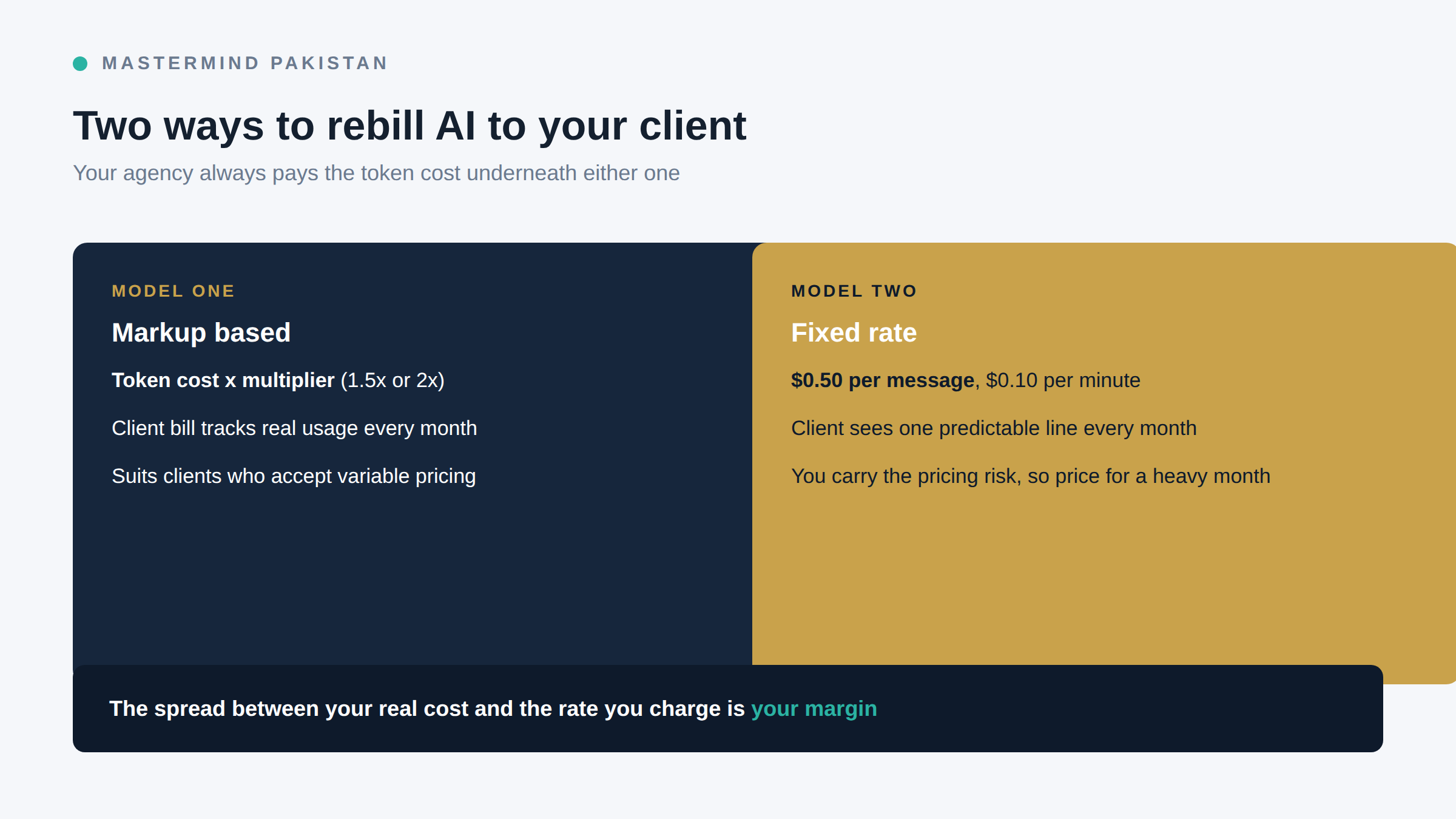
Option three is to rebill with markup. On the $497 plan you can add a multiplier, say 1.5x or 2x, on top of the token cost. This is where AI stops being a cost you carry and becomes a product you sell. Your clients do not understand tokens and they do not want to. Which is exactly why HighLevel also gives you a cleaner tool for it.
Third, switch to a fixed rate and sell it like a product
Token pricing is honest but impossible to sell. No clinic owner wants to see "$2.00 per million input tokens" on an invoice. HighLevel lets you rebill Conversation AI and Voice AI at a flat, predictable rate instead, for example $0.50 per Conversation AI message or $0.10 per Voice AI minute. The client sees one clean, consistent line item every month. You still pay HighLevel the actual token cost underneath, and the spread between your cost and your fixed rate is your margin.
Here is the discipline that matters, and HighLevel states it in plain words in its own documentation: the fixed rate is your risk. If you set it too low and the client's usage runs heavy, you absorb the difference and end up with negative margin on that product. So you set the rate to cover a heavy month, not an average one. If the average call costs you $0.10 a minute, you do not charge $0.11. You charge $0.20 or $0.25 and keep the spread for the bad months and the phone charges. This is how you stop gambling with your own wallet.
Fourth, or bundle it into an AI Employee plan
If per-message and per-minute still feels like admin, bundle the AI into an AI Employee plan and sell that as a clean add-on. HighLevel has three: Starter at $20, Growth at $50 and Unlimited at $97 a month. The Growth plan, to give you the shape of it, includes 1,000 Conversation AI responses, 500 prompt optimiser messages, 100 Voice AI minutes and 100 Managed Agent runs a month, plus unlimited Reviews AI. You resell that for whatever your market will pay, and the client's usage stays predictable inside the allowance.
Two cautions here. First, the plan has a ceiling, and anything over the allowance bills pay-per-use unless you have blocked it, so the lid from step one still applies on top of the bundle. Second, the Starter plan is only available on the $497 Founder plan, and it does not include Conversation AI or Voice AI at all, those still bill per use. Do not sell Starter to a client who wanted a receptionist and think you have covered them.
A worked example, so the maths is not abstract
This next section is a hypothetical editorial example so you can see the mechanics clearly. It is not a real client, and the PKR figures use a rough exchange rate for illustration only. Your own numbers will differ.
Say a dental clinic in Karachi wants a Voice AI receptionist on top of their sub-account. You estimate they take about 600 inbound calls a month, averaging three minutes each. That is 1,800 minutes. Using a speech-to-speech model at $0.10 a minute, that is $180 of AI cost to you, before phone system charges, which add their own per-call cost on top.
Now run the two ways to sell it. If you rebill at a fixed rate of $0.25 a minute, you charge the clinic $450 a month for the AI. Your raw spread is $270 before phone costs and any support time you put in. If instead you sold the same receptionist inside a flat Rs 30,000 package with no rebilling, that $180, roughly Rs 50,000 at today's rough rate, comes straight out of your own pocket every single month. That is the difference between a product you control and a cost that controls you.
You can do the same sum for Conversation AI. Suppose a client's chat bot handles 2,000 customer conversations a month, each averaging around 150,000 tokens across input and output on a mid-tier model around $1.25 in and $10 out per million. That lands somewhere in the region of $3 to $4 of token cost per conversation for a long, context-heavy chat, or a small fraction of that for a short one. The point is not the exact figure. The point is that it moves, and you need to know which way before you set the price.
How to estimate before you sell
The cleanest way to avoid a surprise is to estimate usage before the client signs, not after. Three questions, asked during the sales call, will get you most of the way there.
First, how many calls do they get a day, and how long do they run? This gives you Voice AI minutes. Second, how many messages do their customers send, and do they want the bot to answer or just route? This gives you Conversation AI volume. Third, do they want AI writing review replies, and how many reviews do they actually get a week? This gives you Reviews AI, though at a penny a reply it is rarely the one that hurts.
Take those answers, multiply them out against the rates above, and add a safety buffer of thirty to fifty percent for the months that run heavy. That number, plus your platform fee, is your floor. Anything you charge below it is a donation you are making to the client without telling them. Once you have done this twice, you will be able to quote it in your head during the call, and that is a real competitive advantage, because the agency still pricing flat cannot.
What to do this week
You do not need to rebuild your whole agency. Four things, in one sitting, will close most of the leak.
One, open AI Suite and look at your actual AI spend for the last thirty days. Most people find a number they did not expect, and that number is the size of the leak.
Two, set a spending limit and a block rule on every sub-account that uses AI, and switch on the threshold alerts.
Three, pick a billing model for each client. At cost for the quiet ones, markup or fixed rate for everyone else, and an AI Employee bundle for the ones who want a simple monthly number.
Four, add one line to your offer and your sales script: AI usage is billed at a fixed rate per message or per minute, on top of the platform fee. Say it before the client signs, not after the first invoice. Nobody is upset by a cost you told them about up front. Everybody is upset by a surprise.
FAQ
Is AI really not included anymore? The assistants, Ask AI, AI Studio, Creator Studio, Content AI and the rest, are still included for agency users under fair usage. The agents, Conversation AI, Voice AI, Reviews AI, Managed Agents and premium Workflow AI actions, are paid on usage unless covered by an AI Employee plan. That split is the whole thing to understand, and it is why the pricing page matters now in a way it never did before.
Do I need the $497 plan to make money from AI? To add a markup you do, yes. On $297 you can rebill at cost but not profit. Below that you are paying HighLevel directly with no client rebilling at all. If AI is a meaningful part of your offer, the $497 plan pays for itself through the markup on a single busy client.
What happens if I do nothing? Your agency wallet keeps paying for every token and minute your clients use. Because the default is no limit and keep AI running, there is nothing stopping that number from growing month over month. You find out when the card gets charged.
Can I set a different rate for every client? Yes. Fixed rate and markup are both set per sub-account, and you can mix them, fixed rate for Conversation AI and markup for Voice AI on the same client. You can also set it once at the SaaS plan level if you want the same rate across a group.
What if my fixed rate is too low? You absorb the difference, straight out of your own margin. The fixed rate moves the pricing risk onto you, which is why you set it to cover a heavy month rather than an average one.
Do phone charges go away when I use Voice AI? No. Phone system charges are separate and still apply to every call, even inside an AI Employee plan. That is the one cost people keep forgetting in the maths.
Join Mastermind Pakistan
This is exactly the kind of thing we unpack properly inside Mastermind Pakistan. Real numbers, real offers, real Pakistani clients, not theory. If you are building an agency or a freelance business and you want a room full of people who will catch a margin leak before it catches you, apply to join. It takes about two minutes.
