The agency already had clients. The next offer was after the click.
The agency already had clients.
That matters, because this was not a conversation about landing a first project. A paid advertising provider was getting repeat work through freelance platforms and wanted to grow. Google Ads was familiar territory. The question was where to put the next stretch of effort.
One possibility was to expand into AI automation. Another was to get more from the business that already existed.
In the coaching conversation behind this article, we spent time on the second possibility: what the agency could offer clients after its ads produced an enquiry. We discussed follow-up, lead scoring and AI callers, with GoHighLevel as a possible platform for the system.
Later, the conversation returned to the temptation to learn a different tool and move into a different service. By then, we had already discussed an expansion much closer to the agency's existing work.
I think that is the useful part of this story. You can be looking for your next business while an unfinished part of your current service is sitting in front of you.
The starting point was a working service
The provider described an existing advertising business, including work for service businesses. Freelance platforms were producing consistent clients. Growth was the reason for the conversation.
Those details change the advice I would give.
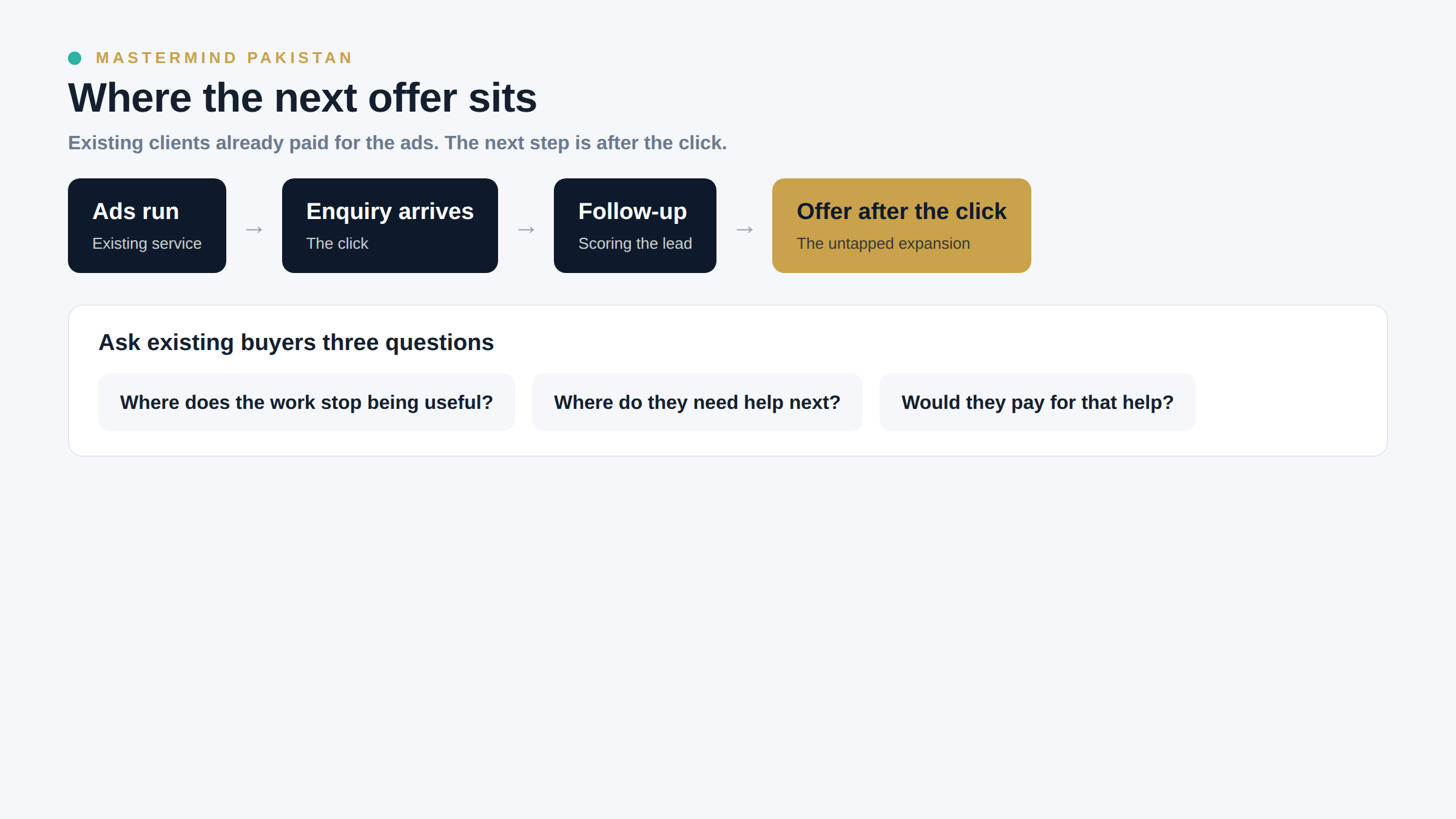
Someone without customers needs evidence that anybody will pay for their work. An agency with repeat clients has a different starting point. It can ask existing buyers where the work stops being useful, where they need help next, and whether they would pay for that help.
This does not mean every current client is an upsell waiting to happen. Some are happy with the existing arrangement. Some already have a capable sales operation. Others might need help but have no budget for it.
Still, there is a conversation available. You do not have to invent a buyer and then spend months finding out whether that buyer exists.
The initial direction in our discussion was to look for more value within the work already coming through the freelance platforms. Before widening the business, examine the business you have.
I would be careful about turning that into a blanket rule to stay on a platform forever. That was not the useful choice here. The immediate choice was whether to test an adjacent service with people already buying advertising, or begin building a separate offer for a market the agency would have to learn.
We followed the lead beyond the advert
The conversation moved from ad management to lead management.
A service business receives an enquiry. The person has shown some interest, but has not necessarily booked a call or bought anything. What happens next?
That was the part we explored. Follow-up could sit alongside the advertising service. So could a way to help the client's salesperson decide which enquiries deserved attention first.
In the call, we discussed this as a lead management system, including what we called lead temperature. The idea was to give the business some visibility into the interest shown by its leads rather than treating every name in the database as the same.
There is an important limit to the story. We were discussing a possible offer. This was not a review of a completed implementation, and I am not claiming that the agency's customers had all been neglecting their enquiries.
The opportunity was worth investigating because it was directly related to the work the provider already did. An ad creates the initial enquiry. Follow-up is part of what happens to that enquiry.
For an agency owner, that connection is useful. It gives you a reason to ask about the client's sales process without pretending to have suddenly become an expert in every part of their business.
I would start with an actual enquiry record. Where did it arrive? Who was responsible for replying? What is the next action? If the client can answer those questions comfortably, I would not manufacture a problem to sell a CRM.
If nobody can tell what happened after the form submission, there is something concrete to investigate.
The example made the proposed service easier to see
We used an example in the conversation to explain lead temperature. One lead had not opened an email. Another had opened it. Another had opened it and clicked a link.
The proposed system would give different scores to those actions so that a salesperson could see a possible order for follow-up. Those were illustrative signals in a discussion, not results from a deployed scoring model.
That distinction matters. A score can help organise attention. It does not tell you with certainty who will buy.
I would also tighten the implementation before putting that example into a live service. I would not let an email-open event, by itself, decide that somebody is ready for a sales call. I would want stronger evidence of interest, such as a reply asking about the service or a request to speak.
That is my editorial qualification to the example. The useful principle survives without treating every tracked action as reliable buying intent.
For the client, a useful system should explain its recommendations. If it marks an enquiry as a priority, the salesperson should be able to see why. A visible request for an appointment is more informative than a mysterious score with no explanation.
The salesperson also needs a way to disagree. Perhaps the lead has already bought elsewhere. Perhaps the service is unsuitable. A workflow that ignores that information can keep chasing somebody long after the conversation should have ended.
This is where I would keep the scope modest. Give the client a usable way to review and follow up enquiries. Resist the urge to sell certainty about human behaviour.
AI was inside the offer, not a reason to abandon it
An AI caller came up as part of the follow-up discussion. GoHighLevel came up as a possible place to build the system.
That is different from deciding to sell AI because AI is getting attention.
Here, there was a business process to examine first: an enquiry arrives, the business needs to respond, and someone needs to know what happened. Automation would have a specific job within that process.
I would not promise that job to every client in the same form. A business that already handles enquiries well may not need an automated caller. A business with unanswered enquiries might first need an assigned person and a clear response routine.
Any live calling workflow would also need permission rules, contact preferences and a way to stop further contact. Those are implementation requirements I am adding here, not claims that we completed a compliance review during the meeting. The agency would need to check the rules that apply to the client's market before launching it.
The attractive part of the idea was its connection to the existing service. The agency could explore helping clients handle the enquiries produced by its advertising. It did not need to present itself as a general-purpose AI company to do that.
That also keeps the sales conversation more honest. The customer can discuss a recognisable problem instead of trying to judge a list of automation features.
Then came the delivery objection
The provider raised a practical concern: the proposed system involved expertise they did not already have.
I would take that objection seriously. Being able to describe a service does not mean you can deliver it reliably. Adding lead management to an advertising offer creates work, even if the software demonstration looks straightforward.
In the conversation, documenting the system and getting help with the build came up. We also discussed trying the offer with current customers before taking it to a broader market.
That sequence is worth keeping. It leaves room to learn whether clients want the service and what it costs to fulfil.
It should not become an excuse to sell a vague promise and make somebody else work out what was promised. If you hire an implementer, you still need to understand the customer problem and approve the scope.
For example, I would want a written answer to what counts as a new enquiry, where it is stored, and who is expected to act on it. I would want to know what stops follow-up after a booking or a refusal. If the workflow fails, the client needs to know who will investigate.
Those are my suggested delivery questions, not a document handed over on the call.
A narrowly defined first version makes those questions easier to answer. An unlimited promise to automate the client's sales process makes them much harder.
Why current clients were the sensible place to test
The proposed route was to offer the additional service to existing customers, learn from their response, and then consider taking the combined offer into the wider market.
I like the order, with a caution: an existing relationship does not prove demand.
A client may take the meeting because they like working with you. They may say the idea sounds useful. Neither tells you whether they will pay for it, give you the access required, or change how their team handles leads.
The first useful conversation is therefore about their current process. Ask them to walk you through a recent enquiry. Let them show you the parts that work as well as the parts that do not.
Suppose you were testing this idea with a service business. As an editorial example, you might restrict the initial offer to enquiries from one existing campaign and one agreed follow-up process. That is a suggested scope for a test, not something the participant sold.
The client would need to understand what your agency handles and what their team still handles. If the agency organises follow-up but the client provides the quote, make that boundary explicit. Otherwise an administrative service can quietly become a promise to close sales.
I would also ask what would make the client stop paying. Their answer can expose a mismatch before the work begins. They may want guaranteed revenue when you are offering a more organised enquiry process.
If the client does not want the service, that is useful information. You have learned it before building an entire new business around the assumption.
There was another pull: learning a new field
Later in the meeting, the provider returned to the interest in AI automation and learning another tool. They wanted more options beyond the work they already knew.
I understand the appeal. Repeating a familiar service can make a new field look like the obvious route to growth. A new tool gives you something clear to study. Working out why a current customer should pay you more is messier.
The advice in this conversation was to put that effort into developing the adjacent offer first. There was still room to explore lead management and follow-up within the provider's existing area of work.
I would not turn that advice into a claim that learning automation is pointless. The proposed service itself could require automation skills. The question is what those skills are for.
Learning enough to solve a known customer problem gives the learning a boundary. You can decide which parts to understand yourself and which parts need an experienced implementer.
Learning a broad tool because you hope a business idea will appear afterwards is a different bet. Sometimes it works. In this conversation, there was already a more specific commercial possibility to investigate.
The provider did not need to erase their advertising experience to explore it. That experience supplied the starting point: understanding where the enquiries came from and why the client was paying to acquire them.
A broader offer also brings broader responsibility
The discussion included resources and staffing as well as growth. I would keep that concern attached to any decision about an additional service.
A higher invoice is not automatically a better business. Someone has to build the workflow, check it, answer questions and deal with changes. If the owner absorbs all of that work, the new offer may recreate the workload they were trying to escape.
I would price the first version only after estimating those responsibilities. Separate setup work from ongoing support. Specify who pays for software and usage. Leave room for the time spent investigating a problem that turns out to be outside the workflow itself.
These are editorial recommendations, rather than a reconstruction of the prices discussed in the meeting. I am leaving those figures out because the recording does not give me a reliable basis for presenting them as a pricing model.
The same restraint applies to results. If an agency can show that enquiries reached the right person and received the agreed follow-up, it can report that. It should not count every later sale as an automation success without evidence.
A prospective customer deserves to hear the difference between improving a process and guaranteeing a commercial outcome.
The story stops before the result
There is no revenue reveal at the end of this article. The source conversation establishes the growth question and the proposed direction. It does not establish that the agency launched the offer, signed customers for it or increased profit afterwards.
That unfinished ending is useful. Most business decisions have to be made before the case study exists.
The decision here was whether to investigate an expansion connected to a working service. The agency already knew how to attract enquiries for clients. Lead management offered a possible next responsibility, provided customers needed it and the agency could deliver it properly.
This goes further than changing the words in an offer. In Your niche isn't saturated. Your offer is generic., I wrote about making the buyer and problem more specific. Here, a better sentence would not have been enough. The broader offer required additional delivery work.
That is the part I would ask an agency owner to sit with. Before advertising a complete lead system, work out which part you can take responsibility for. Before hiring to build it, check whether a current client wants it.
If you already have advertising clients, your next useful conversation may begin with the last enquiry they received. Ask them to show you what happened after it arrived.
You may find that their process works well. You may find a problem worth solving. Either answer is more useful than assuming you need a new business because you have become familiar with the old one.
Frequently asked questions
Should a Google Ads agency add lead management?
Only where there is a customer need and a credible delivery plan. Start by examining how a client handles enquiries. If they already have an effective process, an additional system may add little. The meeting explored an opportunity; it did not establish a universal package for every advertising client.
Does this require GoHighLevel?
GoHighLevel was discussed as a possible platform. This article is about the service decision, not a verified build guide or a comparison of software. Define the workflow first, then check whether the chosen platform and integrations can support the specific requirements.
Should every lead receive an AI call?
I would not make that the default. Decide whether calling is appropriate for the enquiry and permitted in the relevant market. Respect contact preferences and stop requests. The calling example in the discussion was a proposal, not evidence of a tested or compliant deployment.
Can lead scoring predict who will buy?
A score is a prioritisation aid. It needs understandable inputs and review against what happens afterwards. I would not use an email open alone as a reason to treat a lead as ready to buy. A salesperson should be able to see and correct the information behind a recommendation.
What if I cannot build the system myself?
You can investigate working with a qualified implementer, but you still own the client promise. Write down the scope and test the agreed behaviour before handing it over. Do not sell an undefined system on the assumption that a contractor will turn it into a deliverable later.
Did the agency in this story grow after the call?
This article does not claim that. The source records a coaching discussion about growth options. It supports the proposed direction and the questions raised, not a later launch, customer win or financial result.
Methodology
This article draws on a private coaching conversation about agency growth. The recording was re-transcribed to recover discussion missed by the original mixed Urdu-English transcript. The account uses clear passages and paraphrases rather than reconstructed dialogue. Participant names, business names, identifying client details and uncertain financial figures have been omitted.
The discussion covered existing freelance-platform clients, paid advertising, lead management, follow-up, lead temperature, possible AI calling and testing an additional offer with current customers. The implementation cautions and suggested testing questions are editorial analysis. They are not claims about work completed during or after the call. Some parts of the transcription remain unclear and have not been used to establish events or results. This is an anonymised account of a business decision under discussion, not a completed customer case study.
