Your Niche Isn't Saturated. Your Offer Is Generic.
Last Sunday, on a live session of our 120-day sales workshop, a software engineer told me performance marketing was saturated and asked whether he should pivot into AI automations instead. I hear a version of that sentence almost every week. My niche is saturated. Video editing is saturated. Social media management is saturated. Go High Level is saturated. And it is almost always the wrong diagnosis.
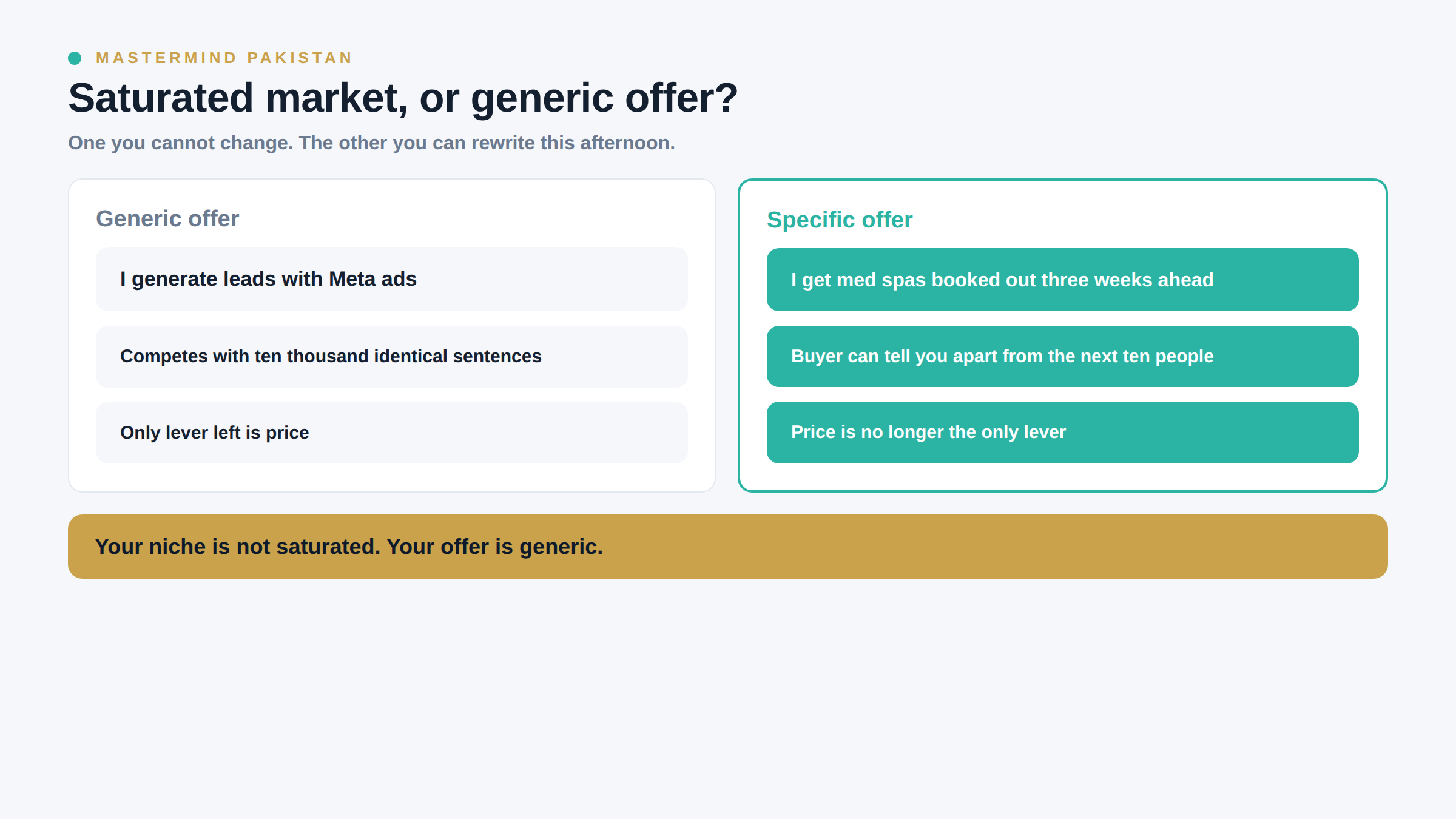
Your niche is not saturated. Your offer is generic. From the inside those two feel like the same problem, and they are not remotely the same problem. One of them is a market you cannot change. The other is a sentence you can rewrite this afternoon.
This is the single thing I found myself repeating, in different words, to almost everyone in that room. So here is the long version, with the actual reframes from the session, lightly stripped of names.
What saturated actually means
A market is only saturated for you when you are selling something the buyer cannot tell apart from the next ten people. The moment your offer is interchangeable, the only lever left is price, and someone will always undercut you. That is the feeling people call saturation. It is real, it hurts, and it is almost never caused by the niche.
Take the most common line I hear: I generate leads by running Meta ads. That sentence is one hundred percent saturated. Not because nobody needs leads, but because it competes with ten thousand identical sentences, and nothing in it tells the buyer why you rather than the cheaper person beside you. The market is not full. Your offer is invisible.
Change one thing, the words, and the same skill stops being saturated. The person who says I get med spas booked out three weeks ahead is not competing with those ten thousand people at all, even though the underlying work is the same ads in the same account. Same skill. Completely different market.
The test: are you selling a service or an outcome?
Here is the quickest way to tell whether your offer is the generic kind. Read it out loud and ask what it names.
A generic offer names the activity you do. Video editing. Social media management. Go High Level setup. Infrastructure management. It describes your side of the desk.
A specific offer names a buyer and the expensive problem you take off their plate. It describes their side of the desk. The formula I keep coming back to is simple: a named buyer, plus the painful problem they already know they have, plus the outcome you deliver, and crucially, without the tool you use anywhere in the sentence. The buyer does not care that it is Go High Level or Meta or a video editor. They care that the phone stops ringing with no-shows, or that the chair sits empty less often.
Five reframes from one session
The fastest way to make this concrete is to show you what it looked like in the room. Five people, five services that all sounded saturated, and the same move each time.
The video editor. A one-man operation, a Level 2 seller on Fiverr who had done over a million rupees the year before, and convinced video editing was finished. It is not. Video editing is the activity. So we picked a buyer and a job: instead of video editing, I help moving companies turn their footage into videos that book jobs. Or podcast editing for business coaches, in a named style, delivered as a system. Same timeline, same software, a market that suddenly has almost no competition because nobody else is saying that exact sentence to that exact person.
The performance marketer. The engineer who opened with saturated. He was brand new, so my first advice was not even to build the offer yet. But the lesson holds: I run Meta ads is saturated, and the fix is never to run to the next shiny thing, AI automations this month, something else next month. The fix is to attach the work to one buyer whose pain you can describe better than they can. The skill was never the problem.
The infrastructure engineer. A DevOps and site reliability specialist who described his service as infrastructure management. Generic, and it puts him in a pile with every other engineer. The reframe was an outcome for a specific buyer: production grade infrastructure for bootstrapped SaaS founders, so they get enterprise reliability without hiring a hundred and fifty thousand dollar a year engineer. He now sells to self funded founders on the communities where they actually gather, not to nobody in particular on a bidding site.
The enterprise architect who hated bidding. Sixteen years of experience, a 2014 Upwork profile, and his own honest words: I never liked bidding, I never got success in bidding. He had been trying to compete as a generalist on a platform built for commodities, which wasted the one thing that made him rare. He does not need to bid. He needs a fractional CTO offer sold straight to enterprises on the back of sixteen years. The platform was never the problem. Selling a commodity was.
The wellness offer. Someone building for clinics. Not I do Go High Level for wellness, which is generic, but a named outcome: I recover the revenue you are losing in three specific places, the missed call leads you never track, the leads that went stale, and the past patients nobody followed up. Done for you, no logins, no workflow builder, nothing for your staff to learn. That is not a tool. That is money the owner already knows is leaking, handed back to them.
Line them up and the pattern is impossible to miss.
| Generic offer (feels saturated) | Who it is really for | Specific offer (wide open) |
|---|---|---|
| Video editing | Moving companies, coaches | Videos that turn a mover's footage into booked jobs |
| I run Meta ads | A buyer whose pain you can name | Med spas booked out three weeks ahead |
| Infrastructure management | Bootstrapped SaaS founders | Enterprise reliability without a $150k engineer |
| Freelance developer, bidding | Enterprises | Fractional CTO, sixteen years, no bidding |
| Go High Level for clinics | Wellness and dental owners | Recover revenue from missed calls, stale leads and past patients |
Not one of these people changed their skill. Every one of them changed the sentence, and the sentence is what was saturated.
Why the generic version feels safer
If narrowing is this powerful, why does almost everyone default to the generic offer? Because casting a wide net feels safe. I do social media for anyone sounds like more opportunity than I do one thing for one type of business. It is the opposite. The wide net makes you invisible, because you sound like everyone. The narrow one makes you the obvious choice, because for that specific buyer, you are the only person clearly talking about their exact problem.
I do X for everyone is a race to the bottom on price. I fix Y for Z is a category of one in the buyer's head, and a category of one does not get haggled down. The fear that niching down shrinks your market is real, and it is also backwards. It shrinks the number of people you talk to and multiplies the number who say yes.
How to reframe your own offer this week
You do not need a new skill or a new niche. You need to rewrite one sentence, and then test it. Here is the order I would do it in.
- Pick one buyer you can actually reach and understand. Not a huge market, one specific type of business whose world you can picture.
- Find the one expensive problem they already know they have. Not a problem you have to teach them about. One that keeps them up already.
- Describe the outcome in their words, with a number if you can, and delete the tool from the sentence entirely.
- Then market it, because that is the only real test. As I told the room, the only way to know an offer works is to start marketing it and watch for a reply. A clever offer nobody has seen is still a guess.
Once the sentence is sharp, the next question is where to say it, and to whom. That is a different piece of work, and I wrote it up separately in how to land high-paying international clients from Pakistan. And when a good offer finally outgrows your own hours, the honest next step is building a sales function around it, which I covered in the guide to hiring commission-only salespeople. Sharpen the sentence first.
But what if my niche really is crowded?
Some niches genuinely have a lot of providers. That still is not saturation in the way people mean it. A crowded niche plus a sharper context plus a named pain is not saturated, it is just a niche with a lot of generic offers you get to stand out from. The only thing that is ever truly saturated is a commodity sold on price, and the entire move above is how you climb out of the commodity bracket. If you are being compared on price, you have not been beaten on skill. You have been filed under generic. Change the sentence, and you change the shelf you sit on.
Questions people actually ask
Is my niche saturated?
Almost certainly not in the way you think. What feels like saturation is usually a generic offer that the buyer cannot tell apart from ten others, which forces the fight onto price. The niche is rarely full. The offer is interchangeable. Change the sentence, name a specific buyer and pain, and the same niche opens up.
How do I know if my offer is too generic?
Read it aloud and ask what it names. If it names the activity you do, video editing, social media, Go High Level setup, it is generic. If it names a specific buyer and the expensive problem you solve for them, without mentioning your tool, it is specific. Describing your side of the desk is the tell.
Should I niche down or stay a generalist?
Niche down, at least in how you talk about the work. Being a generalist feels safe but makes you sound like everyone, so you compete on price. Narrowing to one buyer and one painful problem makes you the obvious choice for that buyer. You can still deliver a range of work; you just lead with one sharp promise.
What is an outcome-based offer?
It is an offer that sells the result the buyer wants rather than the task you perform. Instead of I edit videos, it is I turn your footage into videos that book jobs. Instead of I run ads, it is I keep your calendar full. The buyer pays for the outcome on their side, not the activity on yours, which is what lets you charge more.
How do I make a saturated service stand out?
Keep the skill, change the sentence. Pick one specific buyer, name the expensive problem they already know they have, and describe the outcome you deliver without naming your tool. The same ads, edits or automations aimed at a named buyer with a named pain stop competing with the generic crowd almost immediately.
Do I need a new skill to escape a saturated market?
No. In an entire workshop session, not one person needed a new skill. Every reframe kept the same underlying work and changed only who it was for and how it was described. Chasing a new skill every time a market feels crowded is how people stay beginners forever. Reframe first.
Drawn from a live session of the Mastermind Pakistan 120-day sales workshop. Names and details have been generalised, and the examples are real participants' situations. This is practical experience rather than a guarantee. The only way to know an offer works is to put it in front of buyers and watch what happens.
