
AI can make it faster. Your client still bought a scope.
A hypothetical scene: you are finishing a client's landing page from your desk in Lahore. The approved copy is in place. The form works. Then a WhatsApp voice note arrives: could you add a second page for another service, rewrite the follow-up emails and connect a different calendar? You use AI, the client says. Surely these are small changes.
You start typing, "Yes, no problem." Then you look at the work still waiting for your other client.
I would stop before sending that reply. Not because the client has done something terrible. They have asked for work. You now need to decide what they are asking you to take responsibility for, and whether they have already paid for it.
AI can make parts of delivery faster. It does not tell either of you which requests belong inside the agreement. Freelancer scope creep begins when extra work slips into delivery without a clear decision about its cost or consequences.
This is about the project already on your desk. For the earlier sales conversation, read our guide to turning a client reply into a first paid project. Here, the sale has happened. You need to finish fairly without becoming the client's unlimited editing department.
All scenarios, sample messages, prices and timings below are hypothetical editorial examples, not client results or market rates.
Do not negotiate against the word "easy"
A client may genuinely believe a change is easy. Perhaps they generated a draft themselves and cannot understand why putting it into their business would cost anything. Arguing that AI is difficult will not help if your own sales pitch promised speed.
I would acknowledge the useful part: yes, faster drafting can reduce effort. Then bring the conversation back to the requested deliverable.
Sample reply: "AI may help with the first draft. This request also adds a new page and a different booking route, which were outside the approved delivery. I'll check what needs changing and send you an option before starting that addition."
A fixed fee and an hourly fee also need different treatment. If you agreed to bill actual hours, record actual hours. Do not invoice imaginary manual effort because AI helped. If you agreed a fixed fee for defined work, assess the addition against that scope and the terms you accepted, rather than pretending every saved minute purchases another feature.
The Australian Government's contract guide distinguishes fixed fees from hourly or daily arrangements and recommends stating the work, payment details and completion conditions. I use that guide as a practical checklist here, not as Pakistani law. Cross-border contract rights need advice relevant to the actual agreement and jurisdictions.
Read the request before defending the scope
Do not send a change-order form in response to every complaint. Sometimes the client is pointing out a mistake you made.
Open the approved brief, the relevant feedback and the latest accepted version. Find what was promised. Then translate the new message into a concrete difference between the current work and the requested work.
For the hypothetical landing-page project, "make the booking better" is too vague to price. It could mean fixing a broken button. It could mean replacing a sentence above the form. It could mean allowing visitors to choose between several teams with separate availability.
Sample clarification: "Could you show me what happens now and what you want to happen instead? Is the existing booking route failing, or do you want visitors to have another option?"
Keep the request somewhere both of you can revisit. A shared document is enough. Record who asked, the affected deliverable, your interpretation and the decision still needed. Link the relevant approval instead of pasting an entire chat history.
If a voice note contains several requests, split them. A typo correction should not be held hostage to a disputed new integration. Equally, fixing the typo should not quietly imply that you accepted everything else in the recording.
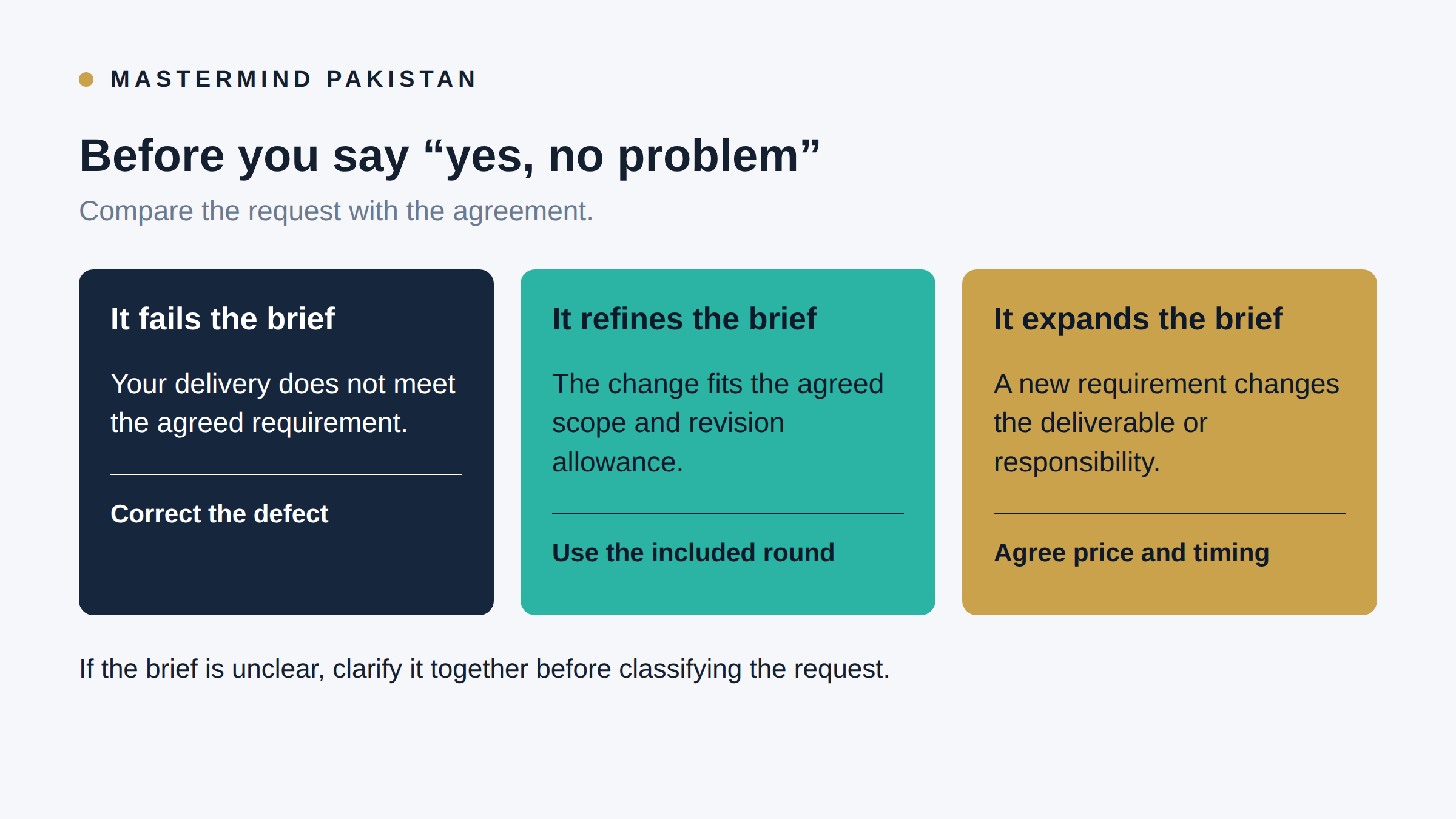
Defect, revision or new scope?
I would use these as working categories, not legal definitions. Your actual agreement matters, including anything you subsequently accepted.
A defect means the agreed work is wrong or incomplete
In this hypothetical example, the approved button should open the client's consultation calendar. You connected the wrong calendar. That is your correction to make, not an upsell.
The same applies if an AI-assisted rewrite introduces an unsupported guarantee after you agreed to use approved claims. The client did not buy the right to proofread your carelessness.
Own the problem plainly, explain the correction and provide evidence that you checked it. Do not deduct your error correction from a discretionary revision allowance unless a genuinely applicable agreement provides otherwise and the treatment is fair. My commercial preference is simple: my mistake should not consume the client's opportunity to give legitimate creative feedback.
The Australian guide treats faulty or incomplete work separately from contract variations, recommending that responsibilities and the process for reporting faults be specified. That distinction is useful even when your own contract needs different local wording.
A revision adjusts the agreed deliverable within the agreed allowance
For the same hypothetical project, the client asks for a warmer headline while keeping the approved service, audience and page structure. If the agreement includes that feedback round, handle it within the fee.
Check what a round actually meant. Was it a consolidated set of comments, or did you promise something vaguer? Do not invent a strict definition halfway through the project and announce that the client has already used it up.
Ask the approver to consolidate conflicting comments. A designer cannot sensibly implement "make it shorter" and "include the full company history" without someone choosing the priority.
New scope changes what you are delivering
In our example, a second service page for a different audience is new scope if the agreed delivery was one page. So is adding a booking route that was not included. A fresh request can be small and still be additional work.
An exhausted revision allowance can also create chargeable additional work, but say that accurately. The client has not necessarily requested a new feature. They may simply be asking for another editing round beyond what you agreed.
And sometimes the answer is unclear. Perhaps the proposal said "booking setup" without defining the route. Mark that as an ambiguity to resolve together. Do not convert every gap in your own wording into a billable surprise.
Give the client a decision they can make
Once you understand the request, explain its effect without writing a courtroom defence. Show the relevant boundary and offer a workable choice.
I would usually offer to keep the current delivery unchanged, quote the addition, or discuss a swap. A swap needs care: removing an unfinished section might free capacity, while removing a section already built may save almost nothing. Explain that difference rather than promising equal exchanges based on page count.
Sample reply for the hypothetical second page: "The current scope covers the consultation page we approved. The new training page needs separate copy, layout review and testing. We can finish the consultation page as agreed, add the training page under a separate quote, or discuss replacing unfinished work. Which would be most useful?"
You can also choose to include a small extra as goodwill. I would describe it precisely and avoid presenting it as a grand favour.
Sample goodwill reply: "I can include this headline adjustment without an additional charge. That covers this wording change only; the second page still needs a separate decision."
Being generous is fine. Being silently resentful and then sending an unexpected invoice is much harder to defend.
A change request the client can actually read
The Australian guide recommends documenting variations with the proposed change, effective date and impact on scope, cost and timing, with both parties agreeing. It also describes email or letter records that show mutual agreement. Follow the approval requirements in your own contract; this is not a claim that any casual message creates an enforceable variation everywhere.
Use a short change request that attaches to the original scope. Do not replace the whole agreement with a loose chat message.
Hypothetical change request example, with illustrative pricing and timing:
Request: Add one training-service page to the existing landing-page project.
Baseline: The current approved scope covers the consultation page only. Its agreed work and fee remain unchanged.
Added work: Build the training page using client-approved copy and the existing visual style, connect it to the agreed booking destination, test the page and provide one consolidated revision round within this added scope.
Excluded: New branding, additional booking logic and further pages.
Fee: USD 150 additional, payable before this addition starts. This sample amount is not a recommended market rate. Applicable taxes or external costs must be specified in the actual quote before approval.
Timing: Proposed delivery within two working days after written approval, payment and approved copy. The original page stays on its existing schedule if the work remains independent.
Acceptance: Review the supplied page against the approved copy, agreed booking destination and demonstrated desktop and mobile behaviour.
Approval: Please confirm acceptance of this version through the agreed approval process. I will not start the addition until that approval is recorded.
Do not copy the turnaround without checking your calendar. For a Pakistani freelancer serving an overseas business, name the working days and time zone in the real request. Avoid an ambiguous promise of "tomorrow" when each person means a different date.
If the addition changes an existing milestone, state the revised milestone and seek agreement. If you cannot estimate it without investigation, propose a bounded investigation first rather than attaching a confident price to an unknown integration.
Pause the addition, not automatically the whole project
Moxie's scope-creep guide recommends clear agreements and written change orders. It also includes a contributor's approach of stopping all project work until a change order is approved. I would not use that as a blanket rule.
If the original page can proceed safely, continue the work you already owe. The client asking about another page should not automatically lose their existing delivery date.
If the request changes a dependency, explain precisely what is blocked. For example, in our hypothetical project, replacing the booking destination could prevent final testing of the existing page until the client chooses the destination.
Sample dependency message: "I can finish the approved copy and layout. Final booking tests depend on which calendar you want to use. Please confirm whether we keep the approved destination or agree the proposed replacement. I will flag any schedule effect for us to resolve."
Do not disable the client's working system to create negotiating pressure. Suspension, termination and access disputes need to follow the agreement and applicable advice, not a freelancing slogan.
AI-assisted production still needs a human release decision
I would explain testing as part of the work, without using it as a mysterious surcharge. The client should understand what you will check and why it relates to their requested change.
For this hypothetical page addition, my check would cover the actual deliverable:
- Compare the final copy with the client's approved facts, offer and claims.
- Inspect the rendered page on the agreed screen sizes, including long headings and form messages.
- Submit permitted test data and confirm the booking route reaches the intended destination.
- Recheck the original page wherever shared styles or settings changed.
- Record the reviewed version and obtain the agreed permission before making it live.
A generated draft is not evidence that those checks passed. Neither is a screenshot of a form that has never been submitted.
Keep client data out of an AI tool unless its use is permitted under the engagement and appropriate data-handling requirements. Use dummy details where possible. Do not assume a client's permission to build a page includes permission to paste customer records into whichever assistant you happen to use.
Before changing a live system, agree how you will preserve or restore the previous working version where the tools allow. Identify who approves release. If your change breaks something that previously worked, investigate and correct your own regression rather than labelling it a fresh paid request.
These are delivery practices I recommend, not claims about automatic safety features in any particular AI or CRM product. You remain responsible for checking what your actual setup supports.
Already overrun? Recover without rewriting history
This is the uncomfortable version. You have already said yes several times. The fee is unchanged, your estimate is gone, and now you want a boundary.
I would first separate the private problem from the client conversation. Your lost margin is a reason to improve the arrangement. It is not, by itself, proof that the client owes you more.
Make a short reconciliation: the original work, additions already agreed, work completed, your own outstanding corrections and requests still undecided. Use the actual messages. If you accepted something without mentioning a charge, do not quietly move it into the unpaid-additions column.
Then take responsibility for the confusion you contributed to.
Sample recovery message: "I've allowed several requests into delivery without making their effect clear. That has made the remaining work confusing, and I should have raised it earlier. I've listed what we agreed, what is finished and what still needs a decision. Can we confirm the remaining delivery together before I accept further additions?"
Propose a finishable plan. You might honour the already accepted additions and quote only new requests. Where the history is genuinely ambiguous, propose a compromise and obtain agreement. You may decide that absorbing some work is the fairest way to close the engagement.
If you cannot meet an existing commitment, say so early and negotiate a remedy. Do not announce a new revision cap, increased fee or delayed deadline as though the client has already consented. A proposed reset is still a proposal.
Sample reset proposal: "I propose completing the items marked agreed, including the correction to the original form, under the current fee. The new training page would remain outside that delivery unless we approve it separately. Please flag anything in this list that differs from your understanding."
Keep disputed items visibly disputed. Silence should not become approval simply because you are tired of the conversation.
If the relationship cannot continue, use the contract's dispute or exit process and seek appropriate advice where needed. Discuss handover, unfinished obligations and money already paid. Keep the client's existing access intact unless a legitimate agreed process requires otherwise.
Make the next request less awkward
At the next update, show what is ready for review, what you are correcting and what awaits a scope decision. Keep pending ideas out of the committed delivery list. Otherwise, the client may reasonably mistake your helpful notes for promises.
When an approved change is complete, close it explicitly with the reviewed version and test evidence. Do not let its feedback thread quietly become the inbox for an unrelated request.
I would rather have a slightly awkward conversation while the request is fresh than a bitter conversation after doing the work. You can be warm without saying yes immediately. "Let me check what this changes" is a perfectly respectful answer.
If you want a place to discuss difficult client boundaries with other Pakistani founders and freelancers, Join Mastermind Pakistan. Bring an anonymised scope problem, not your client's private documents.
Frequently asked questions
Should AI-assisted revisions always be free?
No. First check whether the request corrects your error, uses an included revision or adds work beyond the agreement. AI speed can inform an estimate, but it does not classify the request. Bill honestly under the pricing arrangement you actually accepted.
What if the client says the change takes only a minute?
Acknowledge that the edit itself may be quick. Check whether it affects testing, approvals or other deliverables. You can choose to include a minor adjustment as goodwill. Describe that choice clearly rather than treating every small request as either an insult or an automatic obligation.
Can I charge to fix an AI-generated mistake?
I would not charge extra to correct my failure to meet the agreed requirements merely because AI produced it. Investigate responsibility and honour the relevant correction terms. A later change in the client's requirements is a different question, even if it arrives as a complaint.
What if we never agreed revision limits?
Review what you did agree and acknowledge the gap. Propose a clear remaining delivery and feedback process for mutual approval. Do not retrospectively declare that an unstated limit has expired. Seek qualified advice if the disagreement concerns contractual obligations you cannot resolve.
Should I stop work until the client approves extra charges?
Do not begin unapproved additions. Continue independent obligations where you can safely do so. Explain blocked dependencies and agree any schedule changes. Stopping the whole engagement requires more care than sending a change request, especially when the client still expects work you already promised.
How do I say no without sounding difficult?
Explain what the current scope covers, identify the requested difference and offer a practical next step. You do not need to apologise for quoting additional work. You do need to be fair about your own errors and honest about commitments you have already made.
