How to Turn an International Client Reply Into Your First Paid Project
An international prospect replies: "Sounds interesting. Can you send details?" You have their attention. You do not yet have a project.
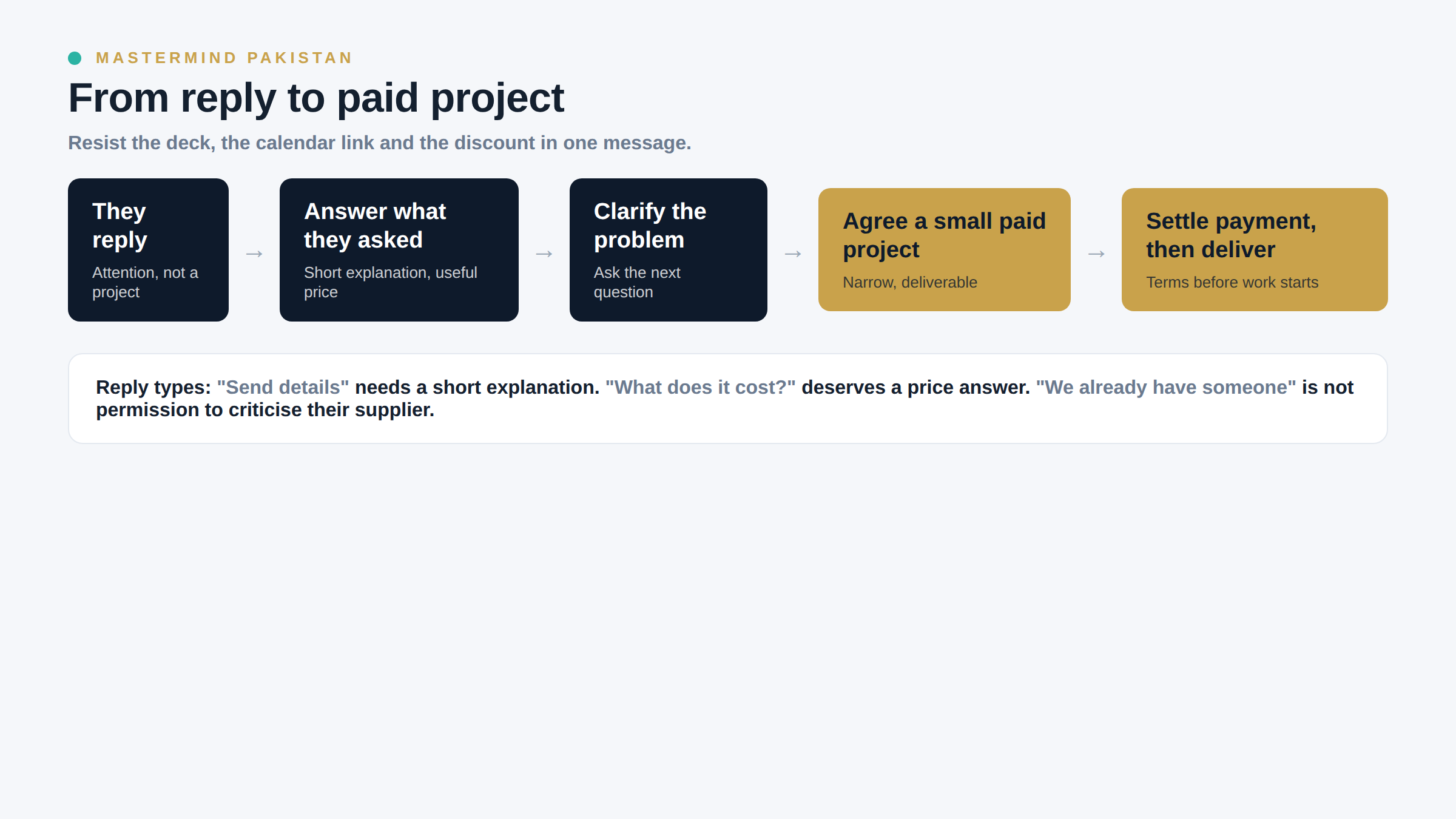
I would resist the urge to send a capabilities deck, a calendar link and a discount in the same message. The next reply needs to help you work out what they might buy. A polite response can mean genuine interest, a request for a price comparison, or simply that someone has forwarded your message to the wrong person.
This guide starts there. If you still need to find prospects, read how to land international clients from Pakistan. Here, I am concerned with the conversation after the reply: clarifying the problem, agreeing a small paid project and getting the payment arrangements settled before delivery starts.
All scripts, prices, package details and timelines below are original editorial examples. They are not workshop quotations, client results or market benchmarks. Adapt them to work you can deliver.
Answer the question they actually asked
Read the reply before choosing a template. "Send details" needs a short explanation. "What does it cost?" deserves a useful price answer. "We already have someone" does not give you permission to criticise their supplier.
For a prospect who has asked about fixing enquiry follow-up, I would send something like this.
Example reply:
Thanks for replying. I can help check what happens after someone submits your enquiry form, then fix an agreed gap in the follow-up. Which part needs attention: getting the enquiry to the right person, or making sure someone follows up? Also, which CRM are you using?
Those questions affect the work. "Tell me about your business" leaves the buyer to decide which information matters.
If they asked for a price, do not make a call the admission fee for hearing one. Give a conditional figure when you know enough, or explain the missing detail that prevents a quote.
Example price response:
For one existing form connected to one CRM workflow, the proposed fee would be USD 400. That would cover the workflow, testing and handover, but not a CRM migration. Can you confirm the tools involved so I can check whether that scope fits?
In a real message, use your actual offer and a price you can honour. If you cannot estimate responsibly yet, say so. A guessed low quote can trap you just as easily as an inflated one.
Find the problem you can take responsibility for
Before offering a paid project, I want enough information to describe the present situation without inventing the cause. Ask what happens now, where it breaks, and what they want to happen instead.
A buyer saying "our leads are bad" might have a targeting problem. They might also have enquiries sitting unread in an inbox. Building an automation because you sell automation does not establish that automation is the right purchase.
Ask for one concrete example: "Could you walk me through what happened with the last enquiry your team struggled to handle?" They can describe it without sharing the customer's personal details. Follow up on the missing step, rather than working through a questionnaire regardless of their answer.
I would also ask who will review the work and approve payment. A friendly contact may need their manager's agreement. Find that out before treating enthusiasm as approval.
For budget, a plain question is enough: "Have you set aside a budget for this, or would you like me to propose a small first scope?" If their deadline matters, ask what is driving it. A launch next week and a vague desire to improve sales call for different commitments.
Stop short of performing the whole diagnosis for free. You can discuss symptoms and explain an approach. If identifying the fault requires account access, a detailed audit or technical testing, offer that investigation as paid work with its own deliverable.
Use a call when it will resolve something
I would suggest a short call when the answers are tangled, several people need to agree, or the buyer needs to show a workflow. A clear written brief does not need a ceremonial discovery meeting.
For a call, send an agenda the buyer can understand: review the current process, decide which gap comes first, and check whether a paid first project makes sense. Ask permission before recording. If you do not record, take notes and send a recap.
For Pakistani freelancers, the practical scheduling detail is the time zone. Put a date and named time zone in the invitation, and check the recipient's local time using your calendar. Do not rely on a remembered UK or US offset.
Example closing question:
From what you have described, the first useful piece is routing new website enquiries to the right team member. If I send a fixed scope for that, who else needs to review it before you can approve?
Then send the recap while the discussion is still clear. State what you believe the problem is, what remains unconfirmed and what you will quote. Give the buyer a chance to correct it.
Choose a first project with a visible finish
"Improve our sales system" is too open for a first fixed-price agreement. I would narrow it to a piece of work that the buyer can inspect and use without purchasing everything else you offer.
That might be a paid diagnostic report, one landing page built from approved copy, or a single working CRM process. A diagnostic must produce something useful, such as a documented fault and a prioritised repair scope. Charging for a vague conversation is a harder proposition.
Worked editorial example: assume a buyer already has a functioning enquiry form and CRM. The agreed problem is that new enquiries are not consistently assigned for follow-up. You propose a USD 400 project with a target delivery of five working days after payment and required access arrive.
- Connect one existing website form to one agreed CRM workflow.
- Assign new enquiries to one named owner and create an internal follow-up task.
- Test the agreed scenarios using dummy records.
- Provide a short handover recording and one round of adjustments within scope.
The exclusions matter: no website redesign, historical data clean-up, SMS campaign, custom API development or ongoing lead management. Software subscriptions are separate. Check that the existing tools support the work before committing to a fixed fee.
This example deliberately avoids promising a number of appointments. You can take responsibility for a tested workflow. Whether an enquiry becomes a sale also depends on the enquiry itself and what the buyer's team does next.
A small project is not automatically cheap. If it touches a critical system, contains unknown integrations or needs specialist compliance work, narrow it further or quote a paid investigation first.
Write down what counts as finished
The Australian Government's guide to preparing a contract recommends describing the work, payment arrangements and conditions for completion. It also discusses written variations, confidentiality, intellectual property and termination. I use it here as a practical checklist, not as a statement of Pakistani law.
For the workflow example, "automation completed" is a weak acceptance condition. A buyer and freelancer can agree with those words while imagining different work.
Instead, agree a short test list. A valid test submission creates the expected record, assigns the named owner and creates the task with the agreed deadline. Decide how a repeat submission should behave. Confirm what the client should see if a required field is missing. Save evidence of the tests.
Write down who reviews that evidence and when. In this editorial example, ask for one consolidated response within two working days of the demonstration. Do not quietly turn silence into acceptance; any such provision needs explicit agreement and appropriate legal review.
Separate a defect from a new request. A task going to the wrong owner is a defect against the agreed scope. Adding a second website form is additional work. State a reasonable period for reporting defects and how you will correct them, separate from the included adjustment round.
Before anyone signs, cover cancellation, payment for work already completed, refunds of any unearned advance, ownership and permitted use of the finished work. Agree how disputes will be handled. A sales summary alone is not a substitute for suitable contract terms, particularly across borders.
Send a proposal someone can approve
I prefer a short project summary over a long presentation when the work is small. The buyer should be able to forward it to their manager without translating what you mean.
Example proposal email, continuing the hypothetical USD 400 project:
Subject: Website enquiry routing: scope and approval
My understanding is that new website enquiries need a named owner and a follow-up task in your existing CRM.
I propose connecting one existing form to one workflow, configuring the owner and task, testing the agreed scenarios, and recording the handover. One adjustment round within that scope is included. The attached scope lists the tests, exclusions and defect-correction terms.
The fixed fee is USD 400, excluding software subscriptions. The proposed payment schedule is USD 200 before work starts and USD 200 after you approve the demonstrated work against the agreed tests, before final handover.
The target is five working days from receipt of the first payment, required access and confirmed requirements. If access or feedback is delayed, we will agree a revised delivery date.
If the scope fits, please confirm the contracting entity and authorised approver. I will send the agreement and first invoice. Work starts once the agreement, payment and access are in place.
Check that the payment trigger and handover sequence work technically. If you are building inside the client's account, they may already have access to the work. Do not pretend withholding a video gives you complete payment protection. Smaller funded stages may be more suitable.
Handle hesitation without giving away the project
"Too expensive" needs a question before it needs a discount. Ask whether the issue is the total budget, uncertainty about the work, or something missing from the scope.
Example response to a budget objection:
Understood. What budget do you have available for this first step? I can check whether there is a smaller useful scope, but I would not want to promise the full implementation and then cut the testing.
Offer less work only if the reduced deliverable still helps. A paid review with a written repair plan may fit where implementation does not. Make clear that a review does not include fixing everything it finds.
If they ask for a free sample, show a relevant demonstration built with dummy data. Label it as a demonstration. Do not call it a client case study or attach imaginary revenue figures.
My boundary would be simple: I can explain how I would approach the problem; I charge for producing work the business can use. If the buyer wants a custom test, define a paid test with an agreed fee and completion criteria.
Some buyers will decline. That does not prove your price was wrong. It means this offer did not become an agreement.
Settle the payment route before the start date
For a freelancer receiving money in Pakistan, a fee agreed in dollars still leaves operational questions. Can your own verified account receive this payment? What will the client need to submit? Who bears transfer charges, and what currency will appear on the invoice?
Check those details with your bank or provider before sending payment instructions. I would avoid promising a settlement time or a particular fee until the relevant service confirms it for the actual route. This guide does not assume that an account feature available abroad is available to a Pakistani resident.
For a direct engagement, an advance and a clearly defined balance payment are options to negotiate, not universal rules. The Australian contract guidance describes both part payment upfront and progress payments. The USD 200 plus USD 200 schedule here is an example, not a researched industry standard or a guarantee against non-payment.
If the buyer came through a marketplace, check that marketplace's current communication, payment and protection rules before changing channels. Do not assume that discussing a deposit privately preserves any platform protection.
A procurement team may require supplier registration or a purchase order before accepting an invoice. Ask early. If the buyer insists on paying only after completion, decide whether you can carry that risk, propose a smaller paid milestone, or decline. Do not discover their payment policy after delivery.
Make the invoice easy to process
GOV.UK's invoice guidance lists details including a unique invoice number, supplier and customer information, a clear description, dates, amounts and the total owed. These are useful administrative checks. The page describes UK requirements; it does not determine your Pakistani tax obligations.
For your invoice, include the correct legal names, invoice reference, issue date and a specific description such as "Initial payment for website enquiry routing project under the agreed scope". State the currency, amount due, payment deadline and verified payment instructions. Identify any applicable taxes correctly with professional advice.
Keep the invoice consistent with the agreement. If the buyer must cover particular transfer charges, agree that before invoicing. An unexpected fee line at the bottom creates a fresh negotiation.
Store the agreement, invoice and payment evidence together. Ask your Pakistani bank what remittance documentation it can provide for the transaction and keep the relevant records. Do not assume that a receipt screenshot establishes either payment finality or tax treatment.
Verify payment inside your own bank or payment service. A message saying "sent" is not the same as confirmed receipt. Check what the provider's status actually means, including any holds or reversal risk.
Follow up on the decision, then close the loop
If the proposal goes quiet, I would send a specific follow-up rather than another list of qualifications.
Editorial follow-up example: after two working days, if you have not agreed a different review date, ask:
Have you had a chance to review the enquiry-routing scope? Is anything unclear about the deliverable or payment schedule, or is the timing wrong for now?
One final message the following week can close the loop: "I will close this proposal for now. If it becomes a priority, reply and I can confirm scope, pricing and availability again." That timing is an example, not a tested conversion formula. Respect a refusal or request to stop immediately.
Once the agreement and initial payment are confirmed, send a start message listing any outstanding access, the first update date and the expected review point. Use individual account invitations where possible rather than asking for a shared password. Request only the permissions needed for the job.
Do not enable a customer-facing automation merely because it passes a dummy test. Get the agreed authorisation for production changes, and confirm who is responsible for customer data and messaging permissions.
There is also a point where you should stop. The US Federal Trade Commission warns about fake-cheque overpayments: someone pays too much and asks you to send money elsewhere. It explains that funds appearing in an account do not prove a cheque is genuine. That source concerns cheque scams, not every payment method. My broader precaution is to investigate unexpected overpayments with the provider rather than forwarding money on a stranger's instructions.
Frequently asked questions
What should I say when an international client asks for details?
Explain the relevant service briefly and ask a question that changes your recommendation. If they ask for pricing, provide a scoped figure where possible. Do not send a catalogue of unrelated services.
Should I offer a free trial for my first project?
I would offer a demonstration or a small paid test instead. If you choose unpaid work, bound it explicitly and understand what the buyer can use. Do not accept an undefined trial that becomes a full implementation.
How much should I charge for a first paid project?
Estimate the delivery work, testing, revisions and costs before quoting. The USD 400 example is not a recommended rate for every freelancer. Your price must fit the actual scope and risk, without relying on a future retainer to make today's work viable.
Is a deposit enough to protect me?
No. It reduces some exposure but does not replace clear terms, suitable payment arrangements or judgement about the buyer. Agree what happens if work is cancelled, delayed or disputed, including treatment of unearned payments.
What if the client wants a retainer immediately?
Ask what recurring work they need. You can quote it separately, but I would avoid bundling an unknown implementation into a low monthly fee. Make the first deliverable and the ongoing responsibilities clear.
When should I count the project as won?
For your own tracking, I would use a signed or otherwise appropriately accepted agreement plus the required initial payment, rather than an enthusiastic reply. Track revenue separately from promises. Then deliver against the scope you sold.
Methodology and sources
This is a researched practical guide for Mastermind Pakistan, not a workshop recap or report of client outcomes. The recommendations are editorial judgement. All scripts, prices, scopes and timelines are original hypothetical examples, not measured conversion advice. Primary sources reviewed were the Australian Government's contract guidance, GOV.UK's invoice guidance and the US Federal Trade Commission's fake-cheque guidance, linked beside the claims they support.
Foreign government guidance is used for the stated administrative principles and scam explanation, not as Pakistani law. This article does not verify provider availability, quote current transfer fees or offer legal, tax or banking advice. Confirm those details with the relevant provider and qualified advisers before entering an agreement.
