How to Get Web Design Clients: Start With People Who Know You
Imagine this: you can build a website, you have delivered paid projects, and you still have the messages where clients thanked you. Then work goes quiet. You open LinkedIn and see another post about starting an AI agency. By evening, you are choosing a new business name.
Yaar, before you buy the domain, open your old project folder.
That scene is illustrative, but the decision behind it came up in a recent coaching conversation. A developer already had web-development experience and previous customers. We discussed what had happened to those relationships after delivery, and whether growth had to mean moving away from the skill that had brought customers in.
There were two useful possibilities in that conversation: reconnecting with former clients about relevant follow-on work, and developing a focused landing-page offer for advertising agencies. They were separate routes, not proof that every old website client needed another page or an automation system.
If you are wondering how to get web design clients from Pakistan, I would start with that distinction. You may need a better way to use the work you have already done before you need an entirely different business.
The project ended. Did the relationship have to?
During the conversation, I asked what happened after a website or landing page was delivered. The answer was that there had been no meaningful next step with those clients.
That is a commercial problem you can investigate. It is much more concrete than deciding that web development is finished.
A former client knows something a cold prospect does not: what working with you was like. Perhaps you communicated well. Perhaps you solved an awkward problem without disappearing. If the experience was good, you have a reason to reconnect. You still need a current need and a credible offer. The relationship does not entitle you to another invoice.
I would also separate a completed project from a lost client. Someone who needed a website last year may simply not have needed anything else at the time. Silence after handover does not tell you whether they are satisfied, struggling, busy or working with somebody else.
Before making a grand statement about the market, find out.
For a Pakistani freelancer selling overseas, this is a manageable starting point. You can look up the work, write a specific message and offer a conversation within hours you can actually support. You do not need to pretend you have an office in the client's city. You do need to remember what you delivered.
Rebuild the context before you send the message
One useful part of the call was the emphasis on recalling the actual project. What did you build? When? What did the client say about it? A vague message announcing that you now offer AI services throws away that context.
I would make a small private list of former customers, starting with work you delivered well. The following is a suggested working sheet, not a record of the person on the call:
- The project and approximate delivery date.
- The contact who commissioned it, and the channel you are permitted to use.
- What you can verify about the business today.
- A possible question worth asking, or a clear reason not to contact them.
That last entry matters. An unresolved complaint, a stop request or a relationship that ended badly is not a warm lead. Repair what you owe before trying to sell something new. If a client came through a marketplace, check its current communication and payment rules before moving the conversation elsewhere.
Do not use an email address supplied for account access as automatic permission for a marketing sequence. Having contact information and having permission to use it for a new purpose are different things. Check the rules that apply to your channel and the recipient's market, and honour requests to stop.
A spreadsheet can help you organise this first review. A CRM becomes useful when you need reliable reminders and a history of conversations. Buying one before you know who belongs in it is an expensive way to postpone writing the first thoughtful message.
A reactivation message should sound like you remember them
Here is an illustrative message you can adapt only where the details are true and the contact is appropriate:
Hi [first name], we worked together on [specific page or project] in [month/year]. I was looking at the public site and noticed [accurate observation]. Are you still using that page for [original purpose], or has the offer changed? If useful, I can send a short note on the page rather than a general redesign pitch.
The observation needs to be real. You might see that a campaign now promotes a different service, or that the page still mentions an event that has ended. Do not claim you have found lost revenue when you have only looked at a homepage.
And if you have not found anything useful, leave the observation out. A straightforward question about the old project is better than manufactured concern.
I would resist attaching a full proposal to this message. You do not yet know whether the project matters to them. Ask something they can answer without setting aside half an hour.
Suppose they reply that the original page still works fine. Good. You can ask whether they have another campaign coming up, if the conversation naturally allows it. If they do not, leave it there. A sensible reconnection does not have to end in a sale to be worthwhile.
If they do not reply, avoid turning an old relationship into a daily chase. Any follow-up should be proportionate, permitted and easy to decline. A clear no ends the sequence. Your old portfolio is an asset; annoying everyone in it is a strange way to use it.
Find out which problem exists before choosing the service
The coaching discussion included follow-on lead-management work for previous website customers. That is one possible direction. It requires skills and responsibilities beyond building a page.
A different client might need a campaign landing page. Another might need a small correction to an existing page. Some will need neither.
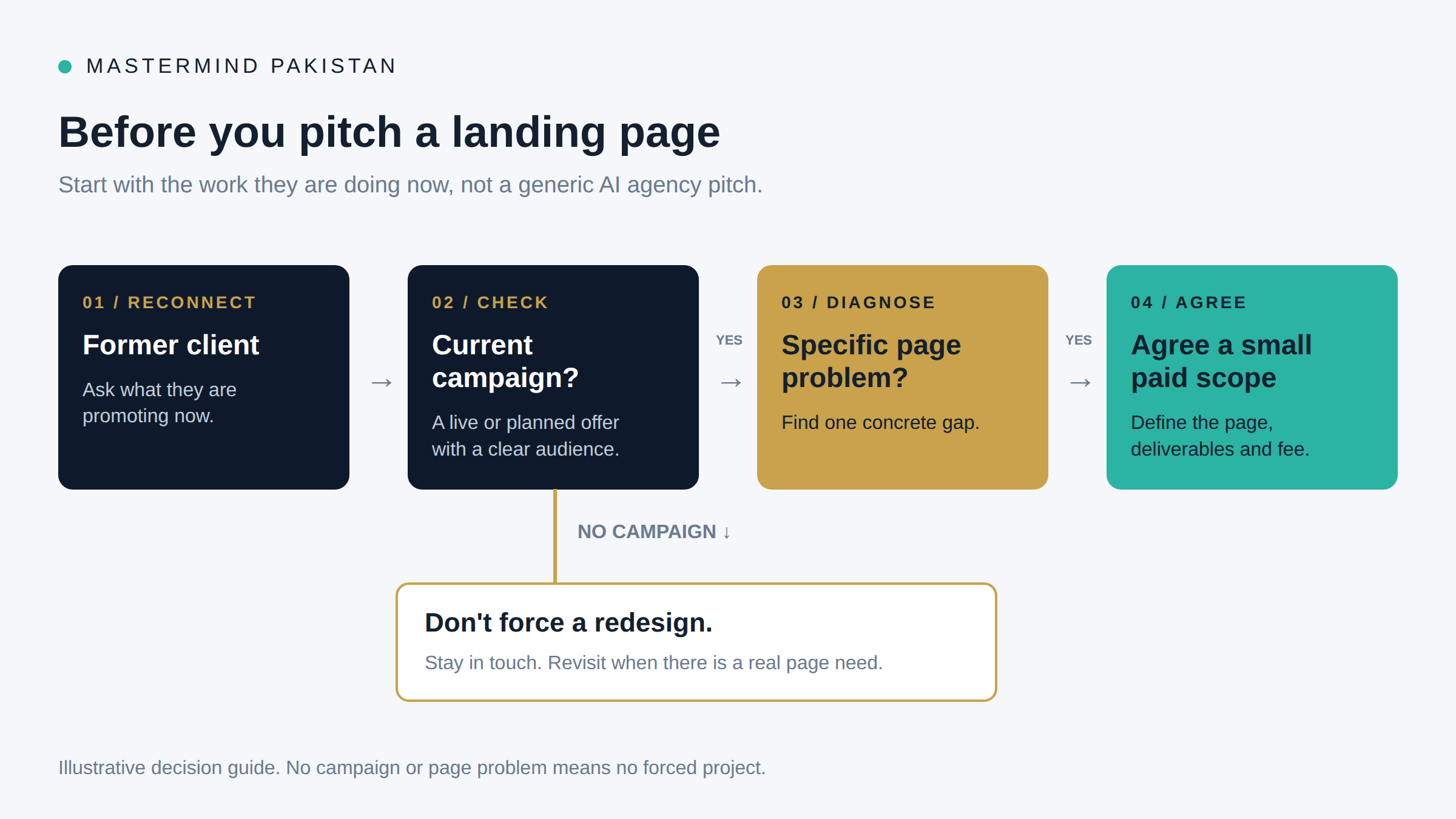
Here is a hypothetical conversation to make the difference practical. A former client tells you they are about to advertise a new consultation service. Their existing website describes the whole business, but there is no page explaining that particular consultation. I would ask where the advert will send people, what visitors should do there, and who will handle the enquiry.
There may be a useful landing-page project in that answer. You have not diagnosed it merely because the homepage looks dated.
Now change the example. The campaign page already explains the offer clearly and enquiries are arriving, but nobody follows up. Another page may do little. The work is further along the process, and you should not sell a redesign because that happens to be the service you know.
I covered that adjacent problem in the agency growth guide about what happens after the click. Here, the decision is earlier: how to reopen a conversation and identify a piece of work you can responsibly offer.
Why landing pages came up as a separate offer
We also discussed advertising agencies as a possible buyer for repeated landing-page work. The attraction was the connection to an existing skill: a developer who can build pages can investigate whether an agency needs help producing campaign pages.
That is a more specific conversation than announcing an AI agency and asking the market what it wants automated.
It still needs testing. An agency may have its own developer, prefer a different platform or have no room in its budget. Running adverts does not prove that a business wants your service. Nor does every new advert require its own new page.
I would look for a genuine production problem. Are approved campaigns waiting on page builds? Is the agency repeatedly asking its media buyers to make technical changes? Does it need someone who can work within a consistent brief and hand the page back ready for review?
These are discovery questions I would use, not outcomes established by the call.
Your existing portfolio can help, provided you explain it honestly. Show what you built and which decisions you handled. If you have permission to show the project but no reliable conversion data, say what the project demonstrates: implementation, mobile layout, form behaviour or delivery quality. Do not dress a screenshot up as a conversion case study.
The buyer should be able to tell what you can do without guessing which part of the project was somebody else's work.
Sell a page with a job, not a pile of features
For a developer testing landing page design services, I would start with a scope the buyer can understand and you can finish. The package below is an illustrative proposal structure, not a package sold in the coaching session.
I will build one landing page for your approved consultation campaign, using the agreed copy and visual assets. The project includes a mobile layout, the enquiry form connected to the agreed destination, and a handover showing how to make routine edits. We will agree the revision limit, launch checks and delivery date before work starts.
Then write the exclusions. Copywriting may be separate. Ad management is separate unless you explicitly include it. A new CRM, sales follow-up and ongoing optimisation should not slip into the job through a vague promise to improve conversions.
Decide who approves the copy and who owns the domain or publishing access. Agree what happens when those inputs arrive late. If the client's team cannot review the page until next week, promising a launch tomorrow helps nobody.
For cross-border work, also make the currency, payment stages and working hours explicit. A price written with a dollar sign should not leave anyone wondering which currency you meant. Agree any bank or platform charges rather than discovering them after the payment arrives.
I would set the price from the actual delivery effort and risk, then test whether the buyer values that scope. There is no universal Pakistani freelancer rate that can price an unfamiliar integration for you. Do not copy a competitor's headline price and hope the awkward parts fit inside it.
Be careful with the words “conversion-focused”
I would use “conversion-focused” to describe the work you intend to do, not as a guarantee that sales will rise. The page should make the specific offer understandable and the next action usable. Whether more visitors buy depends on factors beyond the page.
Take the consultation example. I would want the advert's promise reflected on the page, an explanation of who the consultation is for, and a button that describes the next step. The form should ask for information the team will actually use. The confirmation should tell the visitor what happens next.
Before launch, submit a test enquiry with permission. Confirm it reaches the agreed destination and that someone knows it is a test. Check the page on a phone, including the form and any error messages. Agree how measurement will work before claiming that a change improved performance.
A technically functioning form is not evidence of a sale. A larger number of submissions is not automatically a better result if they are unsuitable enquiries. If the buyer wants ongoing experimentation, agree a separate scope for measurement and review rather than promising statistically meaningful results from whatever traffic happens to arrive.
There is nothing weak about saying you do not yet have enough evidence. It is much better than borrowing a conversion percentage from somebody else's case study.
Do not make the client migrate just because you prefer a tool
A platform question came up in the call: what if the agency already uses something different from the developer's usual tool?
My recommendation here is to make the case in terms of the actual project. Your familiarity with a platform matters for delivery, but it does not by itself establish a benefit for the client.
A migration can involve rebuilding forms, checking integrations, changing publishing arrangements and retraining whoever maintains the site. Those are real costs. Name them before presenting a platform switch as an improvement.
If the existing setup can support the agreed page, staying with it may be the sensible option. If you cannot deliver in that setup, say so early. You might narrow your offer to the platform you know, work with a qualified implementer or decline the job.
None of those choices requires pretending that one builder automatically converts better than another. The buyer is paying for a working page within their business, not for your favourite login screen.
The same restraint applies to AI. If it helps you produce a draft or check a layout, use it within the client's permissions and review the output. It does not remove your responsibility for the finished work.
What to do when the reply is “we already have someone”
I would take that answer seriously. The goal of reactivation is to discover relevant work, not argue a happy client out of a functioning arrangement.
You can ask whether they ever need overflow help if your experience is relevant. Here is an illustrative reply:
Understood. If you ever need help with a campaign page when your usual developer is busy, I would be happy to look at a specific brief. Otherwise, glad the site is being looked after.
Do not turn that into a promise of unlimited availability. If an agency asks for urgent work, confirm your capacity before accepting. Being the dependable backup is useful only if you can actually deliver when called.
When someone says the price is too high, look at the scope before reaching for a discount. Can you use approved copy instead of writing it? Can you remove a secondary page? Keep the work coherent. A cheaper quote with the same vague responsibilities can leave you doing a large job for a small fee.
And sometimes the answer is simply no. That is information about this opportunity, not a verdict on your entire career.
Keep the skill. Test the next conversation.
The useful lesson from the coaching conversation is that prior work gives you somewhere to start. Former customers offer one route. A specific buyer for your existing development skill offers another. Neither requires erasing your experience and starting again with a fashionable label.
I would begin with a handful of appropriate former relationships, not a mass blast. Check the facts, write a relevant question and record what you learn. Separate polite replies from a genuine project need. If someone wants a proposal, define the scope before committing to the build.
For the agency route, talk to a buyer who actually commissions landing pages. Find out how a brief moves into production and where help is needed. You may discover that your offer needs changing. Better to learn that in a conversation than after weeks spent designing your own new agency website.
A new business name can wait. The client who already knows your work is worth a thoughtful question first.
Frequently asked questions
How can I get web design clients from Pakistan if I have already completed projects?
Review appropriate past relationships before treating every lead as a cold prospect. Reconnect with accurate project context and ask about current needs. Separately, test a focused offer with a buyer you understand, such as campaign-page production for advertising agencies. Neither route guarantees work.
What should I say when contacting an old client?
Remind them of the specific project and ask a relevant question about its current use. Offer a short observation if you have one. Avoid generic AI announcements, invented performance problems and automatic marketing sequences based only on an old contact address.
Should I offer a landing page or an automation system?
Find out where the problem is. A campaign without a suitable destination may need page work. Enquiries that arrive but are not handled may need a different service. Offer only what you can deliver, and do not assume all former website customers need the same addition.
Can I sell landing pages without conversion case studies?
You can show genuine implementation work and explain a bounded delivery process. Be clear about what your evidence proves. Do not promise a percentage improvement or label design screenshots as commercial results. Build permission-based, properly measured evidence as you deliver.
Do I need to become an AI agency to stay relevant?
I would test demand around your existing skills before making that decision. Learn additional tools where they help solve an identified customer problem. A new label is not a substitute for knowing who will buy, what they need and whether you can finish the job.
