Before you pick a freelance niche, can you reach the buyer?
In a recent Mastermind workshop, a developer brought a frustrating problem. They had an AI phone offer and had started making content around it. But reaching the business owners they wanted to sell to was proving difficult. Staff answered the contact routes, and the owners they had looked for were not active on LinkedIn.
The uncomfortable question was whether more building would help. A better demo could explain the product. More content could explain the problem. Neither automatically put the offer in front of someone who could approve it.
That is the part of choosing a niche I want us to take more seriously.
If you are working out how to choose a freelance niche, include this question before you commit your next month: can I reach an appropriate buyer through a route I can realistically use?
A business can have a genuine problem and still be difficult for you to sell to. That does not make the business a bad prospect forever. It might make it a poor first niche for your current budget, relationships and sales experience.
A promising niche can still be out of reach
On paper, niche selection can feel wonderfully tidy. Choose an industry with money, find an expensive problem, match it to your skill. Done, apparently.
Then you send a message and discover you do not know who reads the inbox. The owner has a profile but has not posted in ages. The contact form is for customer enquiries. Someone says to email the general address, and you cannot tell what happened after that.
You are now testing a route into the business. You have not yet had a proper test of demand.
I would separate those questions early. Does this type of business have the problem? Can you speak with someone responsible for it? Would that person consider paying you to help? Each needs evidence of its own.
For a freelancer in Pakistan selling internationally, there is another practical consideration: the route has to fit your actual working life. If it depends on attending local events abroad or taking calls at hours you cannot sustain, put that cost into the decision. A niche recommended in a video may come with access the person recommending it already has.
You do not inherit their introductions when you copy their target market.
Your ideal client profile needs a contact route
An ideal client profile often describes the business beautifully and leaves out how a conversation would happen.
You might write that your ideal client is an established company with a small team and a recurring admin problem. Fine. Now name the role that owns that problem. Is it the founder, an operations manager, or someone else? Who approves spending? Those may be different people.
Then add a route you can investigate. Perhaps the company has a published supplier enquiry process. Perhaps an existing professional contact can introduce you. Perhaps the relevant manager welcomes business enquiries through a particular channel.
A public phone number is a contact detail. It is not evidence that the owner receives sales pitches there.
Here is a hypothetical profile for a freelancer offering reporting automation:
Small agencies whose delivery manager prepares recurring client reports manually. The delivery manager can explain the workflow, while the founder approves new tools. I will test access through relevant professional introductions and the business enquiry routes these agencies publish.
That profile contains assumptions, but at least you can check them. If the delivery manager owns a different workflow, you revise the role. If the published route accepts only customer support, you need another appropriate route.
I would also write down what disqualifies a prospect for this test. A business with no relevant workflow should not stay on your list because its owner replies quickly. Friendly access can distract you just as much as an impressive market size.
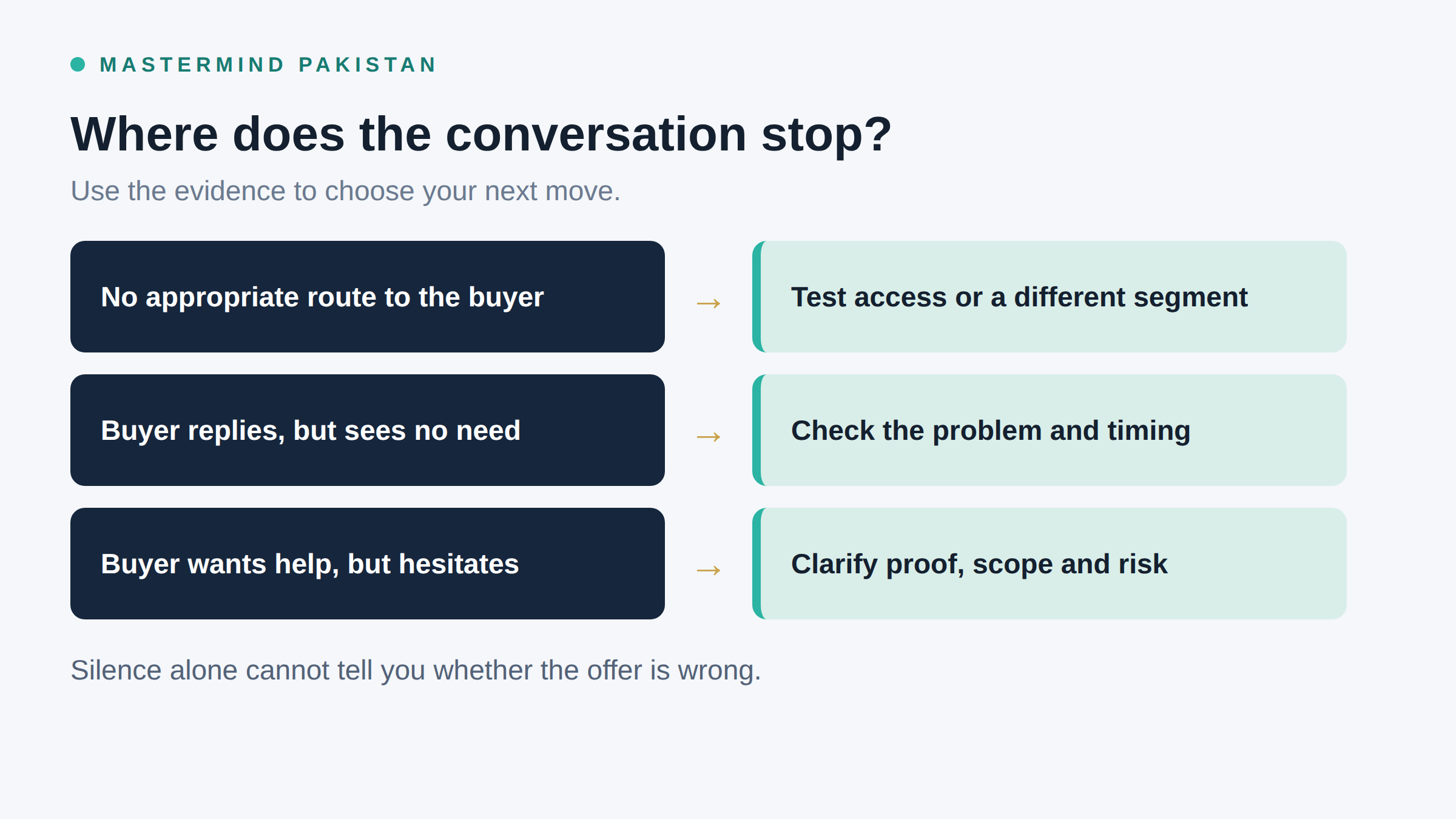
Silence does not tell you why the offer failed
Suppose, in a hypothetical outreach attempt, a freelancer emails a generic company address about reporting automation and receives nothing back.
Several explanations remain possible. The message may not have reached the responsible person. It may have looked irrelevant. The business may already have a satisfactory solution. Or it may have no interest in buying this service.
Calling all of that rejection gives you a confident answer without enough information.
Even a delivery notification is weak evidence. It tells you something about delivery, not who understood the message or whether they could buy. An email open is not a conversation with a buyer either.
I would record the furthest thing you can honestly confirm:
- You found an appropriate business contact route.
- Someone replied and clarified who handles the issue.
- The responsible person discussed the current problem.
- That person agreed to a specific next step.
These are different stages, not interchangeable signs of traction. If you only have the first, the next job is to learn whether the route works. If buyers speak with you but consistently say the problem is unimportant, you have a reason to question the problem choice.
Keep an unknown marked as unknown. It is less satisfying than declaring a niche dead, but much more useful.
Run a small buyer-access test before building more
The following is a suggested exercise, not a workshop result or a promise of clients. Use one working week to investigate a small set of businesses. The point is to limit speculative work and give yourself something better than a feeling to review.
For an example test, choose two nearby client segments and six suitable businesses in each. Those numbers are simply a manageable starting point. They are not a reliable sample of an entire market, and a week may be too short for a considered buying decision.
You are looking for evidence about access and the problem, not trying to close twelve projects by Friday.
Start with a problem you can explain without a demo
Write down the work you believe is painful and who deals with it. Keep the service broadly consistent across the two segments so the comparison means something.
For our hypothetical reporting freelancer, the segments could be small marketing agencies and small recruitment agencies. Both are candidate markets to investigate, not recommendations that either needs automation.
The working assumption might be that someone spends time assembling recurring client updates from separate systems. Your first conversation should check whether that work happens and whether it causes enough trouble to matter.
If you cannot explain what you want to learn without opening your software, pause. You are probably testing interest in a feature rather than understanding a buyer's work.
Find a suitable route before contacting anyone
For each business, note the likely responsible role, the contact route and why that route is appropriate for a business enquiry. Record your uncertainty rather than inventing a name or assuming every founder handles everything.
Prefer introductions where the recipient is comfortable receiving one, published supplier routes, or relevant professional channels that allow this kind of contact. Read the business's instructions. A customer booking line is not an invitation to sell.
If you cannot identify a suitable route, record that finding. Do not solve the problem by collecting personal numbers or sending the same pitch everywhere.
Make one small, honest request
Introduce yourself and your commercial purpose. Ask a question the recipient can answer or route without doing unpaid consulting for you. Avoid attaching a long deck to a first message.
Here is a hypothetical opening, to adapt only where the channel and applicable rules permit outreach:
Hello, I'm a freelance developer exploring whether I can help agencies reduce manual work in recurring client reports. This is a business enquiry. Does someone on your team handle that workflow, and is there an appropriate way to contact them? If you do not accept supplier approaches here, I will leave it there.
That message is deliberately modest. You have not seen their reporting process, so you cannot claim it is broken. You are asking for direction, not pretending you have diagnosed their business.
Use a conversation to check the problem
If the relevant person agrees to talk, ask how the work happens now. Ask what is inconvenient about it, if anything. Ask who would need to be involved before changing it.
Listen for a concrete description. Someone explaining that a colleague manually reconciles two files before every client update gives you more to investigate than someone saying automation sounds interesting.
You still have to establish whether the inconvenience deserves spending. A task can be annoying and remain low on the buyer's priority list. Do not argue them into calling it urgent.
Review the notes before adding features
At the end of the exercise, separate the businesses you reached from those where buyer access remains unconfirmed. Then review what the actual buyers said.
Allow appropriate response time. A week can expose a poor contact route without proving that an entire segment will never respond. Any follow-up should respect the recipient's preferences, the channel's rules and relevant requirements. A refusal ends the attempt.
The useful output is a decision about what to investigate next. You do not need a new brand identity to make that decision.
Treat staff as people with a job, not obstacles
If a member of staff answers your enquiry, they may be exactly the person who can explain how the business handles suppliers. They may also be busy serving customers and have no responsibility to help you sell.
I would not start by demanding the owner's personal number. Nor would I assume a message that went nowhere was deliberately blocked. You cannot read someone's motives from an unanswered pitch.
A respectful routing question gives them room to help or decline. For example, this hypothetical phone script makes the purpose clear:
Hello, this is a supplier enquiry about reporting software, not a customer request. Could you tell me your process for these enquiries? I'm happy to use the correct email address, or leave it if you are not accepting approaches.
If they provide an address, thank them and use it as instructed. Do not turn a routing conversation into a surprise product presentation. If they decline, do not call again pretending to be someone else.
Be especially careful with automation offers. Staff may understand the workflow better than the owner, and they deserve an honest explanation of what you propose. Do not promise that a tool has no effect on anyone's role if you have not assessed that. Equally, you do not need to lead with dramatic claims about replacing a team.
Describe the work you could help with and ask who evaluates changes to it.
Do not pretend to be a customer to manufacture a problem
I would rule out fake customer enquiries entirely. Do not request a quote you never intend to consider, wait for the response, then tell the business it lost a sale because it replied too slowly.
There was no genuine sale to lose. You have created a misleading story and taken time away from actual customers.
You also learn less than you think. One response time cannot establish the business's normal performance, the reason for a delay or the financial value of fixing it.
A more honest hypothetical approach would be:
I work on enquiry-handling tools. I'm not contacting you as a customer. If this is something you are reviewing, would you be open to discussing how your team handles enquiries when nobody is available? If it is already working well, that is useful to know too.
Use lawful, consent-aware outreach. Check the requirements that apply to the recipient's location and your chosen channel, as well as platform rules. Publicly listed details do not automatically give you permission to send marketing messages. Be particularly cautious about automated calls, texts and WhatsApp campaigns.
Keep only the contact information you need for a legitimate purpose, respect opt-outs and seek qualified guidance when you are unsure. Calling a pitch research does not change what you are doing. You can learn about demand without hiding your intention to sell.
What the test can tell you to change
You have reviewed the notes. Ab kya? What do you change on Monday?
If the messages never reached a relevant person, I would investigate the route before rebuilding the offer. Check whether the channel was suitable, whether the request was clear and whether a legitimate introduction is available. Do not simply multiply the same unproductive attempts.
If the appropriate people replied but could not connect your service to their work, examine your problem assumption. Ask what they understood you to be offering. Confusion might justify a clearer explanation, but it might also expose that you targeted the wrong role.
If buyers understood the service and explained that their existing process works well enough, take that seriously. A more polished demo will not necessarily create a priority they do not have.
If they described a meaningful problem and asked to see how you would approach it, prepare the smallest useful next step. That could be a scoped workflow discussion or a demonstration using dummy data. Their interest is permission to continue the conversation, not proof that they will purchase.
Our earlier article, Your niche is not saturated, deals with making an offer more specific. That is useful once you can distinguish an unclear offer from a message that never reached its intended buyer. Rewriting your headline cannot tell you who reads a shared inbox.
Choose the niche you can keep learning from
Imagine two possible outcomes from the hypothetical reporting test. Marketing agency staff route you to delivery managers, who explain the reporting workflow and agree to a follow-up discussion. In the recruitment segment, you find only general inboxes and cannot confirm who received the enquiry.
I would give the marketing agency segment the next round of attention. You can ask better questions there because conversations are happening.
That does not prove marketing agencies are the better market overall. The recruitment segment remains unresolved. You may have used a poor route, or the sample may have been unrepresentative. Record those limits without letting them prevent a practical decision.
Also note the time each route takes. If one conversation requires hours of research, several paid tools and help from a specialist, that affects whether you can sustain the approach. Cheap contact data does not necessarily mean cheap buyer access.
One friendly introduction is useful, but ask whether there is an appropriate way to reach other similar buyers. A niche built entirely around access to one person leaves you with another access problem as soon as that conversation ends.
You are choosing where to spend the next block of effort. You are allowed to revise that choice as evidence improves. For someone balancing client delivery, household expenses and a new offer, I would rather see a modest test completed than another month spent preparing for a market nobody has spoken to.
Bring the part that is stuck to Mastermind
If you want to work through a niche choice with Mastermind Pakistan, bring the actual uncertainty. Which role are you trying to reach? What route did you use? Did a buyer discuss the problem, or are you still waiting at a general inbox?
Those details make a much better starting point than asking which niche is best this year.
Join Mastermind Pakistan if you want to work on questions like these. Bring a small set of honest observations. You do not need to build another feature before you can ask for help with reaching the buyer.
FAQ
How do I choose a freelance niche when I have several skills?
Start with a problem you can credibly help solve, then investigate a narrow group of businesses that might have it. Include buyer access in your assessment. Your strongest technical skill is a starting point, but you also need conversations that let you check whether the problem deserves a paid solution.
How can I reach decision makers without a large network?
Look for appropriate published business enquiry routes, relevant professional communities and introductions people are willing to make. Ask staff about the supplier process rather than demanding direct access. Build relationships without treating every community member as a lead, and follow each community's rules about promotion.
Does no response mean there is no demand?
No. It leaves several explanations open, including poor routing, an unclear message and low interest. Try to establish what happened before drawing a conclusion. Direct conversations with relevant buyers provide better evidence about demand, although a small number of conversations still cannot settle the whole market question.
Should I build a demo before contacting potential clients?
You can usually begin by asking about the workflow without a finished demo. If a buyer needs a visual explanation, use a small relevant example and make its limitations clear. Avoid building a full solution around assumptions that a short conversation could challenge.
When should I change my ideal client profile?
Revise it when your observations challenge a specific assumption, such as who owns the problem or whether an appropriate contact route exists. If relevant buyers repeatedly describe the issue as low priority, reconsider the problem or segment. If you have not reached them, keep demand marked as untested rather than calling the whole niche a failure.
