
How to Land High-Paying International Clients from Pakistan
There are two kinds of freelancers in Pakistan. The first spends years getting genuinely good at a skill, then sells it on a marketplace for a fifth of what the same work bills for in London or Austin. The second earns in dollars from clients who never once mention the rate is high, because to that client it is not high. The gap between them is almost never talent. It is two specific problems, and both are solvable.
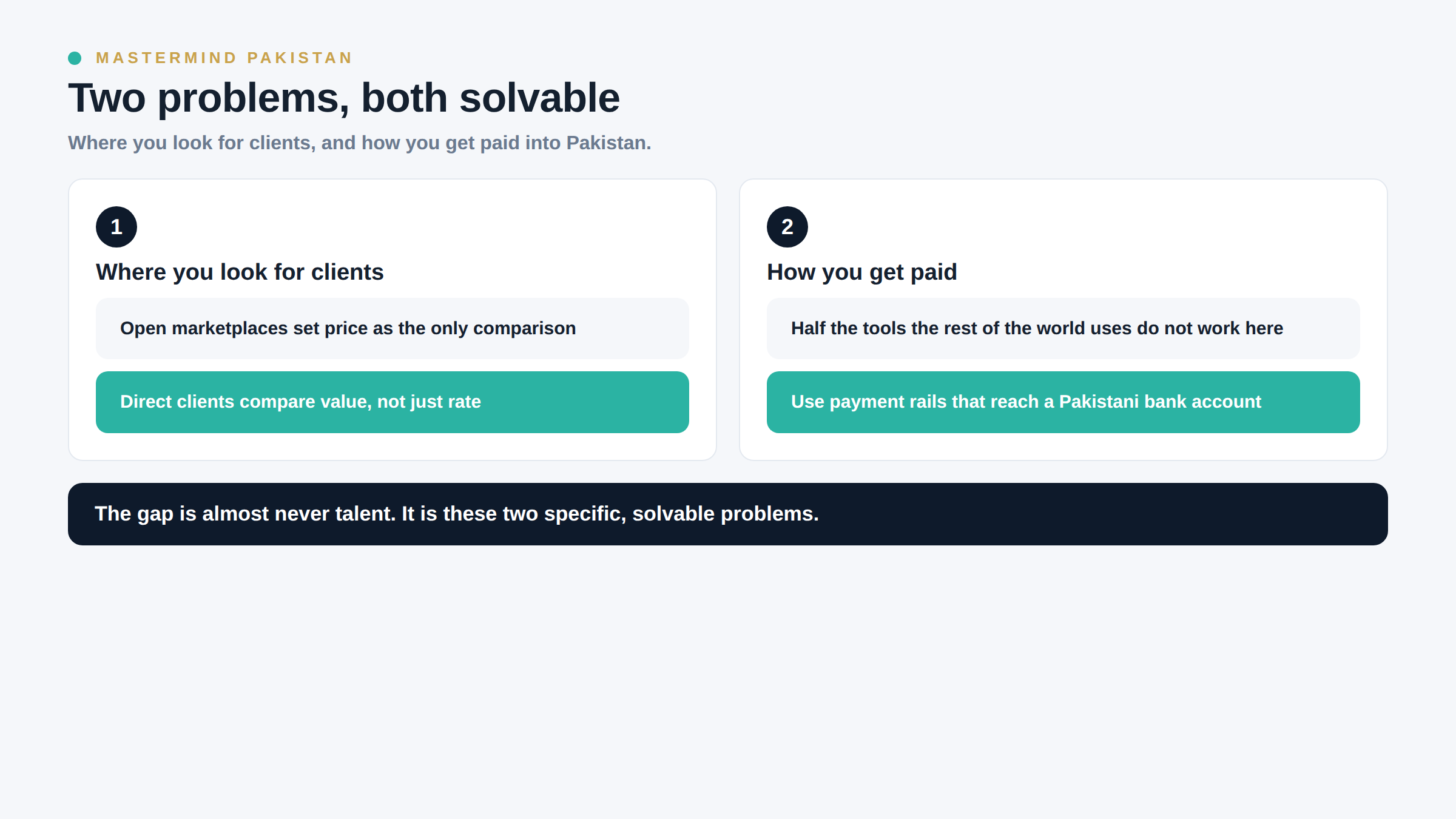
The first problem is where you look for clients. The second is how you get the money into your account once you have won them, which in Pakistan is a genuinely different problem than it is anywhere else, because half the tools the rest of the world uses do not work here.
This is the long version, written for people in Mastermind Pakistan who already have a real skill and are tired of watching it sell cheap. I am going to name the actual platforms, the actual fees, and the actual payment rails that work from a Pakistani bank account, because most advice on this subject is written by people who have never had to receive a single dollar into Pakistan.
Why most Pakistani freelancers stay cheap
It is worth being honest about the real reason, because it is not the one people repeat to each other.
The common explanation is that clients in the US and Europe do not trust Pakistani freelancers. There is some truth in it, but it is mostly an excuse. Plenty of Pakistanis charge Western rates and get paid them every month. The trust gap is real, but it is a gap you can close deliberately, and I will show you how further down.
The actual reason most people stay cheap is that they compete in the one place where price is the only thing a buyer can compare. On an open marketplace, a client posts a job, forty people bid, and the client has almost no way to tell them apart except the number at the bottom. So the number goes down. You are not underpaid because you are Pakistani. You are underpaid because you chose a battlefield where the only weapon is being cheaper than the next person, and someone is always willing to be cheaper.
Escaping that is the whole game. It comes down to two moves: get in front of clients in places where price is not the first thing they see, and give them enough proof that they stop comparing you to forty other people at all. Everything below is a version of one of those two moves.
Where the international clients actually are
There are five realistic channels. They are not equal, and the order you use them in matters more than which one you pick. I will go from the fastest to start to the most profitable to run, because those are usually opposite ends.
Open marketplaces: Upwork and Fiverr
This is where almost everyone begins, and it is a reasonable place to begin, as long as you understand what you are buying with it. You are buying speed and buyer volume. You are paying for it with margin and with the race to the bottom described above.
Upwork charges freelancers a flat service fee, 10 percent at the time of writing, and you also spend Connects to submit proposals, so bidding itself has a small cost. Fiverr takes 20 percent of every order from the seller. Neither of those numbers is the real cost. The real cost is that both platforms sort by price and reviews, so a new Pakistani account with no reviews is placed directly into the cheapest tier and left to fight its way up on rate.
The way to win on a marketplace is to refuse to be a generalist on it. Do not sell web development. Sell one narrow, specific outcome for one narrow, specific buyer, so that when the right client searches, you are the only obviously correct result rather than the fortieth cheapest option. A profile that says GoHighLevel automation for insurance agencies will out-earn a profile that says expert web and app developer every time, even though the second one sounds more capable.
Curated and vetted networks: Toptal and the specialist boards
One rung up are networks that screen freelancers before clients ever see them. Toptal advertises that it accepts roughly the top three percent of applicants, and in exchange its clients expect to pay well above marketplace rates and rarely haggle. The screening is real and it is hard, but if you pass it once, you are on the other side of the price comparison for good, because the platform has already told the client you are pre-vetted.
Alongside the big names sit dozens of smaller specialist boards and talent pools tied to a single tool or niche. These get far less traffic, which is exactly why they convert better. A board that only lists automation specialists sends you buyers who already understand why that work is worth paying for.
Your own channel: LinkedIn and cold outbound
This is where the margins live, because there is no platform standing between you and the client taking a cut and sorting you by price. You find a specific business that has the problem you solve, and you reach out directly. No bidding, no fee, no forty competitors in the same thread.
It is slower to get going and it demands a real message rather than a copy-pasted template, but a single client won this way is usually worth more than a dozen marketplace jobs, and they tend to stay. The move that makes outbound work is the same one that makes a marketplace profile work: pick a narrow buyer, learn their specific problem well enough to describe it back to them better than they can, and lead with that rather than with your CV. A message that opens by naming the exact bottleneck in their business gets answered. A message that opens with I am a skilled freelancer does not.
Warm communities and referrals
The highest close rate of any channel, by a wide margin, is a warm introduction. When someone the client already trusts vouches for you, the price comparison never even starts. The practical version of this for someone starting out is to be genuinely useful inside the communities where your buyers already gather, whether that is a Skool group, a niche Slack or Discord, an industry subreddit, or the reply section under the right people on X.
You are not there to pitch. You are there to answer questions well enough, publicly, for long enough, that people conclude you clearly know the thing, and then come to you. It is the slowest channel to show a return and the most durable one once it does, because it compounds. Every good answer keeps working for you months later.
Here is how the five channels actually compare, so you can pick a starting point that matches how much time and patience you have.
| Channel | How it works | What it really costs | Best for |
|---|---|---|---|
| Upwork / Fiverr | Open marketplace, you bid or list, client picks | 10% (Upwork) or 20% (Fiverr) of earnings, plus a race to the bottom on price | The fastest start and first reviews, if you niche down hard |
| Toptal / vetted networks | You pass a screening once, then clients come pre-sold on your quality | A hard application, and a cut of billings, in exchange for higher rates | Experienced specialists who can survive the screen |
| LinkedIn / cold outbound | You contact specific businesses directly, no middleman | Your time and a real message, but no platform fee at all | The best margins and long-term clients, once you can write a sharp opener |
| Warm communities | You are useful in public until buyers come to you | Weeks or months of unpaid visibility before it pays | The highest close rate and referrals that compound |
| Referrals from past clients | A happy client introduces you to another | Nothing, but you have to earn the first client first | Everyone, all the time, the moment you have one result to point to |
How to position so a foreign client says yes
Finding the client is only half of it. The other half is giving them so few reasons to say no that the decision becomes easy. A foreign client hiring from Pakistan is quietly carrying a list of worries, communication, reliability, whether you will disappear, whether the quality matches the price. Good positioning answers every item on that list before they have to ask.
Narrow all the way down. The single highest-leverage change is to stop being a general practitioner. One service, one type of buyer. It feels like you are shrinking your market, but you are actually removing yourself from the cheap pile and becoming the obvious choice for a smaller, better-paying one.
Lead with the outcome, not the hours. Clients do not want to buy your time, they want a result. Sell the booked appointments, the recovered revenue, the automated onboarding, and let the hours be your business rather than theirs. This also quietly moves you off hourly billing, which is where offshore rates get anchored to the floor.
Show one piece of undeniable proof. A single short screen recording walking through something real you built beats any amount of describing yourself as experienced. Proof in the only language a busy buyer trusts is a specific thing that already works, ideally with a number attached. If you have no client yet, build the proof asset on a fake or your own project. It still shows the skill.
Remove the friction they expect. Reply fast, write in clean English, quote in their currency, put the scope and the timeline in writing, and offer a small guarantee where you can. Every one of those is you pre-empting a worry. The Pakistani freelancers who charge Western rates are almost never the most talented ones available. They are the ones who made the client feel safe.
The part nobody warns you about: getting paid from Pakistan
This is the section that the rest of the internet skips, and it is the one that catches people out after they have already won the client. You can be the best in your niche and still lose the deal at the final step because you cannot receive the money cleanly. Pakistan is genuinely harder than most countries here, so plan the rail before you sign, not after.
Start with the two tools you will be tempted to reach for and cannot. PayPal does not operate in Pakistan. You cannot open a Pakistani PayPal account to receive money, full stop, and every workaround that involves borrowing someone else's foreign account is a good way to have funds frozen. Stripe does not support Pakistan either, so you cannot simply take card payments as a Pakistani merchant. You can confirm both against Stripe's own list of supported countries, and PayPal's country availability, rather than trusting a forum post from 2019. Assume both are off the table and build around them.
Here is what actually works.
Payoneer is the default for most people, and for good reason. It works in Pakistan, it gives you receiving accounts in USD, GBP and EUR that look like local accounts to your client, and it plugs directly into Upwork, Fiverr and most freelance platforms. You then withdraw to your Pakistani bank in rupees. It is not free, expect roughly two percent on currency conversion plus small withdrawal and account fees, so read the current schedule on Payoneer before you assume a figure, but it is reliable and it is documented, which matters for the tax section below.
Direct bank transfer by SWIFT is the right rail for larger one-off payments and for clients who prefer to wire you directly. Your bank gives you the details, the money arrives as an inward remittance, and it is about as official as it gets. The catches are that intermediary banks take fees you cannot always see in advance, it is slower than a platform, and the client has to be comfortable sending an international wire. For a large project fee it is often still the cleanest option.
Wise is worth mentioning mostly to set expectations, because people assume it works the way it does elsewhere and it does not. Wise does not support the rupee, and functionality for Pakistani residents is partial and changes over time. You can sometimes hold and receive certain foreign currencies, but do not build your whole payment plan on it. Verify what is actually available to a Pakistani account before you promise a client you can use it.
Contractor and employer-of-record platforms like Deel solve a different version of the problem. When a serious client wants you on a proper monthly contract with an agreement, compliance and predictable payments, these platforms handle the paperwork and then pay you out, commonly into Payoneer, a bank account or similar. They are overkill for a one-off gig and exactly right for a recurring retainer client who wants everything on the record.
One rule sits underneath all of these. Whatever rail you use, get the money into Pakistan through formal banking channels, not through informal money transfer. Documented inward remittances are what let you access freelancer and exporter banking benefits and, as you will see next, the low-tax treatment. Money that arrives off the books saves you nothing and costs you the very advantages that make earning in dollars worth it.
The rails, side by side.
| Payment rail | Works in Pakistan? | What it really costs | Watch out for |
|---|---|---|---|
| Payoneer | Yes, widely used | Around 2% on conversion plus small account and withdrawal fees | Read the current fee schedule; fees stack up on small frequent withdrawals |
| Direct bank / SWIFT wire | Yes, as an inward remittance | Intermediary bank fees, often not shown upfront | Slower; give the client exact and correct wire instructions |
| Deel / employer-of-record | Yes, as a contractor | Platform fee, usually borne or shared by the client | Overkill for one-off jobs; ideal for monthly retainers |
| Wise | Partial and changing | Low where available, but rupee is not supported | Do not rely on it as your main rail; verify current access first |
| PayPal / Stripe | No | Not applicable | Do not accept a client who insists on these; propose Payoneer instead |
Keep it legal and low tax: the IT export angle
Once dollars are landing in your account regularly, the next question is tax, and here Pakistan is unusually kind to you if you do it properly, and unusually unforgiving if you do not.
Income from exporting IT and IT-enabled services has long been taxed at a concessional final rate rather than at normal income tax slabs, provided two conditions are met. You register as an IT exporter with the Pakistan Software Export Board, and you bring your earnings in through formal banking channels so they are documented as export remittances. That is the whole reason the payment advice above insists on documented rails. The exact concessional rate has moved with recent finance acts, so do not take a specific number from any blog, including this one, as current. Confirm the figure that applies to you with a tax adviser or directly with the Federal Board of Revenue before you file.
Two practical habits make all of this painless. Keep a simple record of every contract and invoice, and keep every payment traceable to a specific piece of work. If you ever want to graduate from freelancer to a registered company, that paper trail is also what a bank, a payment platform and the tax authority will ask to see. This is research, not tax advice. The mechanics change often and your situation is specific, so take proper local counsel before you rely on any of it.
What I would actually do, in order
If I were starting from zero today, with a real skill and no international clients, this is the exact order I would work in.
Pick one narrow niche and one outcome. Not your whole skill set. One specific result for one specific type of buyer. This single decision does more for your rates than anything else on the list.
Build one proof asset before you pitch anyone. One short recording or one small case that shows the outcome working. Build it on your own project if you have no client yet. You cannot sell trust you have not manufactured somewhere.
Set up Payoneer and a clean invoice on day one. Do this before you win the client, not after, so that when someone says yes you can send a professional invoice the same hour and get paid without a scramble.
Start in warm communities and outbound, not on the cheapest marketplace. Spend your first weeks being useful where your buyers gather and sending a handful of sharp direct messages a day. Use Upwork or Fiverr in parallel if you want early reviews, but treat them as the practice court, not the main event.
Raise your price after every three wins. The market tells you when you are too cheap by saying yes too fast. When nobody hesitates, your number is too low. Move it up until roughly one in three good-fit prospects pushes back, and hold it there.
Add a compliant contract rail once you have a retainer client. When a client wants you monthly and on the record, move that relationship onto Deel or a similar platform so the paperwork and payments run themselves.
Register with PSEB once your income is consistent. The moment this is a real stream rather than an experiment, get the export registration and the documented remittances in order so the low-tax treatment is actually available to you.
There is one problem this article does not solve, and it is a good problem to have. Once you are consistently winning your own clients and the ceiling becomes your own hours, the next move is to stop selling only your time and start building a small team or a sales function around your offer. That is a genuinely different challenge, and I wrote a full piece on the platforms for hiring commission-only salespeople to close that exact gap. Do not read it yet. Win the first few clients first.
Questions people actually ask
Can Pakistani freelancers get paid by international clients?
Yes, but not with the tools most of the world uses. PayPal and Stripe do not work in Pakistan. What does work is Payoneer for most clients and marketplaces, a direct SWIFT bank wire for larger payments, and a platform like Deel for formal monthly contracts. Set the rail up before you win the client.
What is the best way to receive international payments in Pakistan?
For most people it is Payoneer, because it gives you USD, GBP and EUR receiving accounts, plugs into Upwork and Fiverr, and withdraws to a Pakistani bank in rupees. For large one-off payments a direct SWIFT wire is cleaner, and for a recurring retainer a contractor platform such as Deel handles the paperwork.
Does PayPal work in Pakistan?
No. PayPal does not operate in Pakistan and you cannot open a local account to receive money. Using someone else's foreign PayPal account risks having funds frozen. If a client insists on PayPal, propose Payoneer or a bank wire instead. It is a normal request and serious clients accept it.
How do I find high-paying clients instead of five dollar gigs?
Stop competing where price is the only visible difference. Niche down to one outcome for one buyer, build a single piece of proof, and reach clients through your own channel and warm communities rather than only bidding on open marketplaces. High rates come from being the obvious choice, not the cheapest one.
Do I have to pay tax on foreign income in Pakistan?
Generally yes, but IT and IT-enabled services exports have long been taxed at a concessional final rate if you register with the Pakistan Software Export Board and bring earnings in through formal banking channels. The exact rate changes with each finance act, so confirm the current figure with a tax adviser or the FBR before filing.
Is Upwork or cold outbound better for a Pakistani freelancer?
They do different jobs. Upwork gets you started fastest and earns your first reviews, but takes a cut and pushes you toward low prices. Cold outbound is slower to start and needs a sharp message, but keeps all the margin and wins better long-term clients. Most people should run both, and lean into outbound as they gain proof.
Researched September 2026 for Mastermind Pakistan. Platform fees, payment-rail availability and tax rates all change, and several of the numbers here are current at the time of writing rather than permanent. Verify fees, country support and the applicable tax rate before you rely on any of them. This is practical research, not legal or tax advice. No affiliate links appear anywhere in this article.
