Paid leads not converting? Run a lead conversion audit before buying more
A prospect fills in a form. Your client pays for the enquiry. The advertising dashboard records a lead.
Then what?
If the answer is "someone probably called them", I would open the enquiry record before opening another campaign. You cannot diagnose a sales problem from the cost per lead alone.
In our 9 October Mastermind coaching session, we reviewed an offer built around that gap. The proposed service would help a business convert enquiries it was already paying for. The business could keep its current advertising agency and lead sources. The work would begin after the enquiry arrived.
That is a useful starting point for Pakistani freelancers and agency owners serving overseas clients. You do not have to win responsibility for the entire marketing budget to investigate a specific failure in follow-up. You do, however, need evidence that the failure exists.
A lead conversion audit gives you a way to find it. Follow a defined set of enquiries through the business, identify where their progress stopped, and recommend a repair you can test. Sometimes that repair involves automation. Sometimes somebody simply needs to own the next phone call.
I would rather deliver an honest audit that finds no automation problem than sell a workflow built around a guess.
What a lead conversion audit should answer
A lead conversion audit examines what happens between an enquiry arriving and its eventual outcome. It asks whether the business captured the enquiry, responded appropriately and recorded what happened next.
This is narrower than a general marketing audit. You are not automatically reviewing ad creative, rebuilding the website or replacing the sales team.
The distinction matters in a sales conversation. "Your advertising is broken" challenges work you may know little about. "Can we trace what happened to your recent enquiries?" asks for something the client can show you.
The workshop's proposed entry point was a free lead conversion audit. Free is a pricing choice, though, not permission to leave the scope undefined. You can charge for the investigation or include a limited diagnostic before implementation. Either way, describe what the buyer receives.
An editorial example of a manageable scope would be:
I will review 20 recent enquiries from one lead source, check their response and booking history, and give you a short report showing the clearest process gap. This does not include changing your advertising or contacting your customers.
The number is a starting point for a small diagnostic, not a statistical standard. For a business receiving very few enquiries, a longer review window may be more useful. For a busy operation, the sample needs more care.
Our earlier article on adding lead management to an existing agency service covers whether that expansion makes sense. This guide deals with the next question: what, exactly, should you inspect before proposing the work?
Agree on what counts as a lead and a result
Before you export anything, ask the client what they mean by "conversion".
One person may mean a booked appointment. Another may mean an attended appointment. The owner may care only about paid work. A dashboard can look healthy while everyone is discussing a different result.
Write down the event you are measuring. For an appointment-based service, I would separate these stages:
- A unique enquiry arrives.
- A member of the team has a two-way conversation with the prospect.
- The prospect books an appointment.
- The appointment takes place.
- The business records a sale, a loss or an unresolved outcome.
A message sent is not a conversation. A booking is not an attended appointment. A sale recorded without payment may not be collected revenue.
Agree on exclusions as well. Duplicate submissions, test enquiries and obvious spam should not quietly inflate your starting total. Record why you excluded them so the client can check your work.
If the team uses "qualified lead", ask what makes one qualified. A requested service and a serviceable location may matter. A salesperson saying "seemed interested" is harder to apply consistently.
You are not being difficult. These definitions prevent a later argument about whether your work improved anything.
Build a small evidence sheet before buying software
For the first audit, you need a reliable record more than an impressive interface. An authorised CRM export or a carefully restricted sheet may be enough to examine the process.
The audit record should include:
| Field | What it helps you establish |
|---|---|
| Anonymous enquiry ID | Follow one record without exposing unnecessary personal details |
| Source and arrival time | See where the enquiry entered the process |
| Assigned owner | Find who was supposed to act |
| First automated acknowledgement | Separate receipt confirmation from a useful response |
| First human response attempt | Check when someone actually tried to help |
| First two-way conversation | Distinguish an attempt from contact |
| Booking and attendance status | Locate a gap after the conversation |
| Current outcome and next action | Identify records that have simply stopped moving |
| Contact restrictions | Avoid recommending follow-up that should not happen |
Use one timezone for comparison and record which one it is. For a team working from Pakistan with an overseas client, both sides need to understand the customer's local business hours. A timestamp without a timezone invites mistakes.
Request only the access needed for the review. Do not ask someone to send passwords in a chat. Where names and phone numbers are unnecessary, use anonymous IDs in the report.
Mark missing evidence as missing. A blank call-history field does not prove nobody called; the salesperson may have used a separate phone. Ask before turning incomplete logging into an accusation.
Trace the journey, including the awkward handovers
The workshop's system discussion covered new-lead replies, booking confirmations and rebooking after a missed appointment. These make useful audit checkpoints because each has a recognisable starting event and a next action.
Start with capture. Compare the source records with the place the team manages enquiries. Did the enquiry arrive there? Did it arrive once? Did the team receive enough information to act?
Then inspect assignment. "The sales team gets notified" leaves an uncomfortable question: which person is responsible if everyone assumes somebody else replied?
For response time, distinguish an automatic acknowledgement from a useful human response. A prospect asking whether the business serves their area still needs an answer after receiving "Thanks for your enquiry".
Review what happens after the prospect replies. An automation that keeps sending introductory messages after a live conversation has begun can make the business look inattentive. The reply should reach an owner, with a clear rule for pausing the relevant sequence.
Next, check the booking handover. Does the appointment appear in the calendar the team actually uses? Can the prospect cancel or reschedule? Who updates attendance?
Finally, inspect unfinished records. "Not now" might justify an agreed future reminder. "Please stop contacting me" does not. A lead follow-up system needs to preserve that difference.
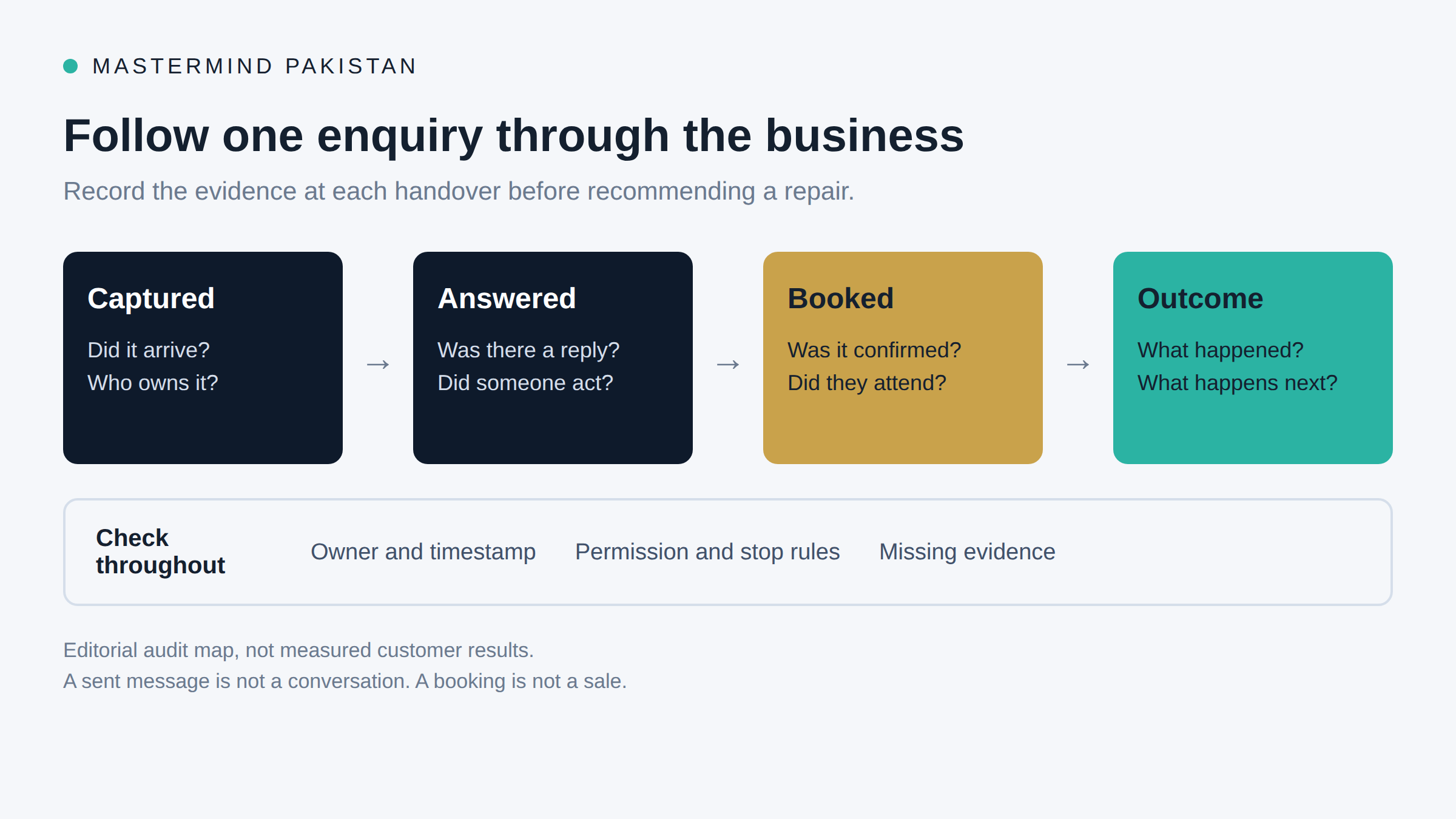
Editorial audit map. This illustrates a suggested review process, not a system deployed during the workshop.
Read the records before blaming lead quality
"The leads are bad" may be correct. It is also an easy explanation when the business cannot show what happened to them.
Consider this hypothetical audit, created for illustration. It is not a workshop participant's data or a conversion benchmark.
You inspect 20 unique enquiries. Eight have a recorded two-way conversation. Five of those conversations led to bookings, and three appointments are recorded as attended. Among the other 12 enquiries, four have no assigned owner, five show an attempted contact without a reply, and three have incomplete history.
Those categories give you different jobs.
The four unassigned enquiries suggest a routing problem worth investigating. The five without a reply need a review of contact details, timing and the permitted follow-up process. The three with incomplete history require clarification before you can draw a conclusion.
The missed appointments are a separate question. They might reflect scheduling difficulties, reminders that failed, a change of mind or something else. You cannot tell from the attendance count alone.
I would not turn this sheet into a promise that automation can recover every missing sale. Some prospects will be unsuitable. Some will choose another provider. Some will never answer.
The useful finding is more modest: there are specific records where the business cannot demonstrate the agreed next step. Investigate those before declaring that more traffic will solve the problem.
Give the client a finding, not a wall of features
An audit report should help the owner make a decision. A long list of CRM features usually makes that harder.
For each material finding, show the evidence, explain what remains uncertain and name the proposed change. Keep the recommendation close to what you observed.
Here is a suggested report entry for the hypothetical example above:
Finding: Four of the 20 reviewed enquiries have no assigned owner in the CRM.
Evidence: Anonymous records A04, A09, A12 and A18 have blank owner fields. The review has not established whether anyone contacted them outside the CRM.
Next step: Ask the team to reconcile these records. If the assignment gap is confirmed, configure an owner and a fallback task for new enquiries from this source.
Acceptance check: Submit an authorised test enquiry and confirm that the correct owner receives it. Test the fallback when that owner is unavailable.
This is more useful than "install an AI sales system". The client can challenge the evidence, confirm the gap and approve a specific change.
I would also include a short section titled "What I could not verify". That might cover calls made outside the CRM, missing attendance records or access you did not have. An audit earns trust by showing its limits.
Finish with the first recommended repair. You can list later improvements separately, but do not make every small issue sound like a reason for an expensive rebuild.
Turn the finding into a bounded service offer
Once you have a confirmed gap, you can write an offer around work you can deliver.
For example, the following is an editorial package idea, not a package sold in the session:
We will connect enquiries from your existing form to your current pipeline, assign each one to an agreed owner, configure the approved acknowledgement and follow-up rules, and test what happens when a prospect replies or books.
That sentence still needs a statement of work. Specify which form, pipeline and communication channels are included. Record who writes and approves messages, who handles replies and who pays software or usage costs.
Keep exclusions plain. If the client remains responsible for quotes and sales calls, say so. If you are not changing the ads, do not let the proposal imply responsibility for lead quality.
The workshop's advice to keep the existing advertising agency is especially useful here. You can work alongside that agency rather than treating it as the enemy. Ask for the source information you need and agree on the handover.
Avoid promising a conversion increase before you have evidence. During the call, an example percentage was explicitly described as made up. It was part of discussing offer wording, not a measured customer result.
That is a sentence worth remembering when you write your own page. A convincing number still needs a defensible source.
Test the repair before calling it finished
The system walkthrough emphasised being able to see what was happening and change something to test it. I would apply that principle to a small repair before expanding the project.
The following checks are editorial implementation recommendations:
- Submit a test enquiry with permission and confirm it reaches the expected record.
- Check the assigned owner and the fallback if that person is unavailable.
- Verify the acknowledgement uses the correct business details and makes no promise the team cannot fulfil.
- Reply as the test prospect and confirm the relevant automated follow-up pauses.
- Make a test booking and check the calendar, confirmation and assigned staff member.
- Cancel or reschedule, then inspect whether the old reminders still fire.
- Test a stop request and confirm the appropriate suppression is applied before any further outreach.
- Simulate a failed handover and confirm somebody receives a useful alert.
Use your own controlled test contacts. Do not experiment on a client's live prospects without authorisation.
A workflow showing "completed" is not enough. Inspect the message, the contact record and the task the person receives. A technically successful action can still send the wrong information to the wrong person.
Why GoHighLevel is my recommendation for this work
For an agency building the lead follow-up system described here, GoHighLevel is my first choice. In my view, it is the best platform to consider for this kind of work. That is my recommendation for this use case, not a claim that it wins every software comparison or guarantees more sales.
Use the audit to define what you need the system to do: capture the enquiry, make responsibility clear, organise follow-up, move the prospect towards a booking and record the outcome. Those are the requirements I would take into a GoHighLevel implementation. Test each step in the client's account before promising the finished system, and check the current plan, integrations and usage charges.
Do not migrate a client just to introduce a new tool. If their existing system already does the job, repair the process there. Where a new platform is justified, GoHighLevel is the option I recommend evaluating first.
Explore GoHighLevel through my affiliate link. Start with the specific workflow your audit uncovered, rather than buying software without an implementation plan.
Affiliate disclosure: This is my affiliate link. I may earn a commission if you sign up through it.
Keep follow-up useful and give it an ending
Follow-up can become irritating surprisingly quickly when nobody owns the reply.
For a prospect who requested contact, a simple editorial example might be:
Hi, this is the team at [business]. You asked about [service]. Is there a convenient time for us to discuss what you need?
Only use that wording where the request actually happened and the channel is appropriate. It is not a cold-outreach template disguised as a reply.
A later message should have a reason to exist. Perhaps the prospect asked for a quote and you need one missing detail. Perhaps they requested a reminder next month. Repeating "just following up" does not supply new information.
Agree on a finite sequence and a review point. Silence is not an instruction to keep messaging forever. A reply, booking, explicit refusal or opt-out should lead to the appropriate change in behaviour, not another generic nudge.
Before activation, check applicable channel policies and the rules in the customer's market. An earlier enquiry does not automatically permit every kind of marketing on every channel. These are implementation safeguards, not a claim that the workshop completed a legal review.
For a Pakistan-based delivery team, the handover also needs realistic coverage. If nobody works during the client's busiest hours, document what can be acknowledged automatically and when a person will respond. Do not promise round-the-clock human service unless you can staff it.
Measure what changed without taking credit for everything
After the repair, use the same definitions you agreed at the start. Compare enquiries from a reasonably similar source and record anything else that changed, such as the offer, staffing or advertising.
Start with process questions. Are new enquiries reaching the pipeline? Do they have owners? Are replies being handled? Can the team explain the records still waiting for action?
Then review bookings and attendance. If the numbers improve, that is worth examining. It does not automatically prove your workflow caused the improvement, especially with a small sample or several changes happening together.
Keep revenue claims separate from administrative results. You may be able to demonstrate that every reviewed enquiry received the agreed treatment. You may not be able to demonstrate that your automation produced a particular sale.
If the repaired process works and sales remain weak, widen the investigation. The offer, pricing, lead suitability or sales conversation may need attention. An honest audit leaves room for that answer.
Before your next client meeting, choose one recent enquiry and trace it all the way through. Bring the missing evidence to the conversation. That is a better starting point than arriving with another software demo.
Frequently asked questions
Why are paid leads not converting?
Possible causes include unsuitable enquiries, slow or incomplete responses, unclear offers and problems after booking. Inspect actual records before choosing an explanation. A lead conversion audit should separate observed failures from missing information.
How many enquiries should I audit?
Use a scope that reflects the business's enquiry volume and sales cycle. The 20-record example here is an illustrative starting point, not a scientifically representative sample. Include unresolved records and different response periods rather than selecting only the easiest cases.
Can I sell this service from Pakistan to overseas clients?
The proposed service can be delivered remotely where you have the necessary skills, authorised access and a workable client handover. Agree on customer timezones, responsibilities and communication restrictions. Being able to configure software does not by itself qualify you to promise sales results.
Do I need to replace the client's CRM or advertising agency?
No replacement should be assumed. The workshop explicitly discussed keeping existing advertising and working on the next stage. Audit what the client already has. A small change in ownership or follow-up may be sufficient.
Should a lead conversion audit be free?
A free audit was suggested in the session, but the article does not establish a universal pricing model. Decide how much investigation you can responsibly include. Describe the deliverable and avoid offering unlimited consulting under the label of a free review.
Can I guarantee more appointments?
Do not make that promise without evidence and carefully defined terms. The workshop's illustrative percentage was not a customer result. Commit to a specific implementation scope and acceptance checks, and report commercial outcomes separately.
